
The size has no tolerance.
Without a tolerance and method, a chest width is judged by guesswork. Give each point of measure a unit, method and allowed plus or minus.
POMUnitTolerance
This free tech pack template is an Excel file that tells a factory in China exactly what to make and how it will be checked. Download it, fill in the seven tabs, and send it with your sample request. It is built for apparel and includes a spec page for other products.
Without a tolerance and method, a chest width is judged by guesswork. Give each point of measure a unit, method and allowed plus or minus.
“Cotton” is not a spec. Write the blend, the weight in g/m², knit or woven, the finish, and the shrinkage you will accept.
A screen image means matching by eye. Give a Pantone code and card edition, and send a physical swatch.
A tech pack is the set of documents that tells a factory what to make and how the result will be checked. A tech pack template gives the fields and layout; you supply the product details. For clothing, it links flat drawings, the bill of materials, the size chart with tolerances, construction notes, and label and packing rules. Use one revision for sampling, production and inspection, and log each change as a new one. A template or filled example is not an approved pattern or fit test.
A tech pack holds seven things: flat drawings, a size chart with tolerances, a bill of materials (BOM), construction notes, color, labels and packing, and a revision log, all for one product and one set of approved references. Flats show the views the factory needs; they do not replace a pattern or a measured sample.
The BOM lists each material and trim with blend, weight, knit or woven build, color, source and usage per unit. For fabric, add accepted shrinkage and any wash, such as stone or enzyme. Name the print method, such as screen print or heat transfer, and its wash test. Give color as a Pantone code with card edition, and keep the approved swatch or lab dip.
The size chart sets finished measurements, the grade between sizes and a tolerance per point. Construction notes cover seams and stitches; labels and packing cover artwork, placement and cartons. The revision log shows which version is live. Mark an unknown value as a question, not a default.
| Section | What goes in it | Who supplies it |
|---|---|---|
| Cover | Style ID, product name, version and approval status. | Buyer or designer; factory confirms |
| Technical flats | Front, back, side and detail views, labeled and versioned. | Designer or technical developer |
| BOM | Each material and trim: blend, weight, color, source, usage. | Buyer or developer; factory confirms |
| Spec & grading | Points of measure, units, sizes, grade rules, tolerances. | Technical designer or pattern maker |
| Construction | Seam and stitch types, stitch density, process notes. | Technical developer; factory may propose |
| Labels & packing | Artwork revision, placement, folding, polybag, carton. | Buyer or designer |
| Revision log | What changed, why, when, and who signed off. | Document owner and approvers |
| Item | Example or open field | What to confirm |
|---|---|---|
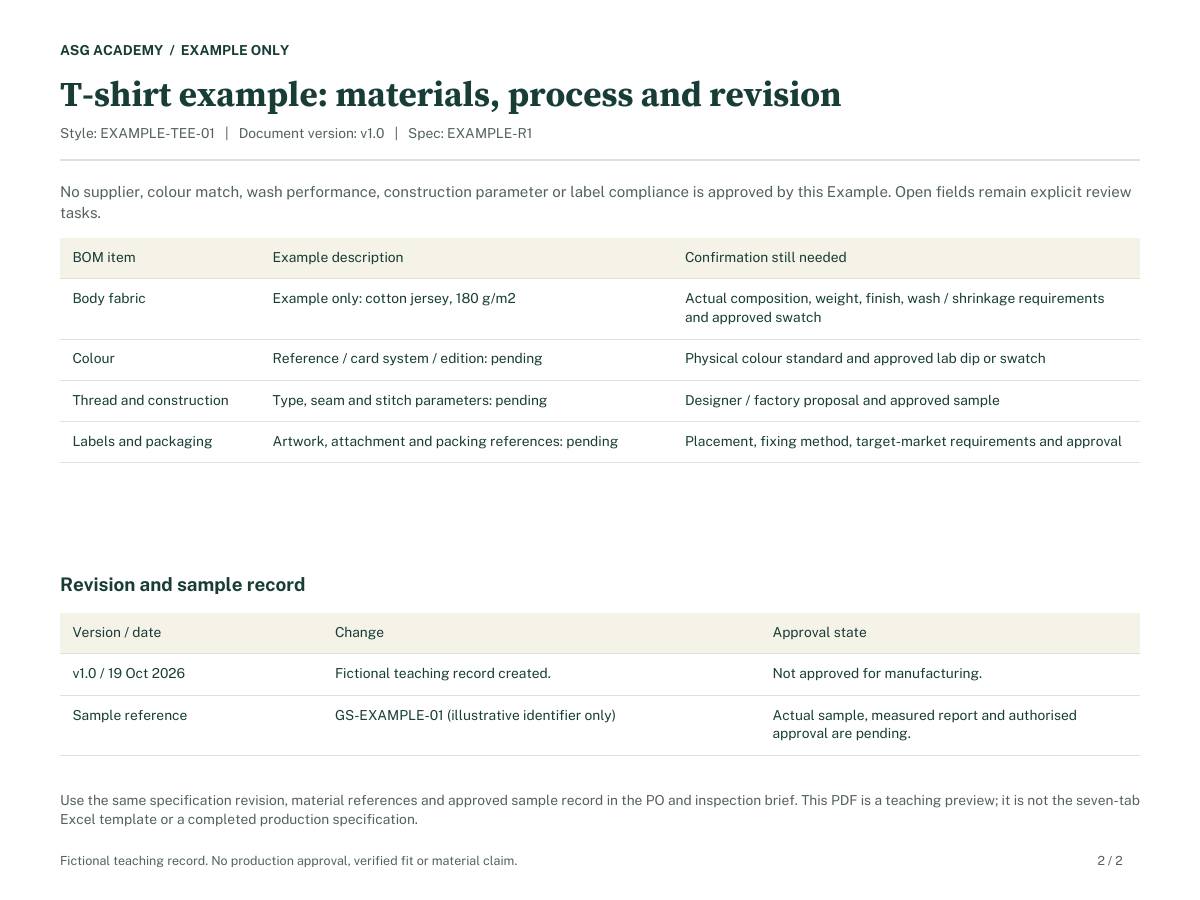
| Shell fabric | Example: 80% cotton / 20% polyester, knit, 320 g/m² | Real blend, weight, build and approved swatch |
| Wash and shrinkage | Limit and test method to agree | Real process, test method and sample result |
| Screen print or heat transfer, to review | Artwork, fabric fit and wash test | |
| Color | Code, system and card edition to record | Approved swatch and lab dip |
| Usage and source | Amount per hoodie and supplier to confirm | Pattern basis, real usage and approved source |
A size chart should name its size system, such as US or Asian sizing, and list the finished measurement at each point of measure (POM). Factories in China often use a smaller Asian scale, so send real measurements, not just labels. Set the grade, which is how much each point grows between sizes, and give every POM a tolerance, such as ±0.5 cm.
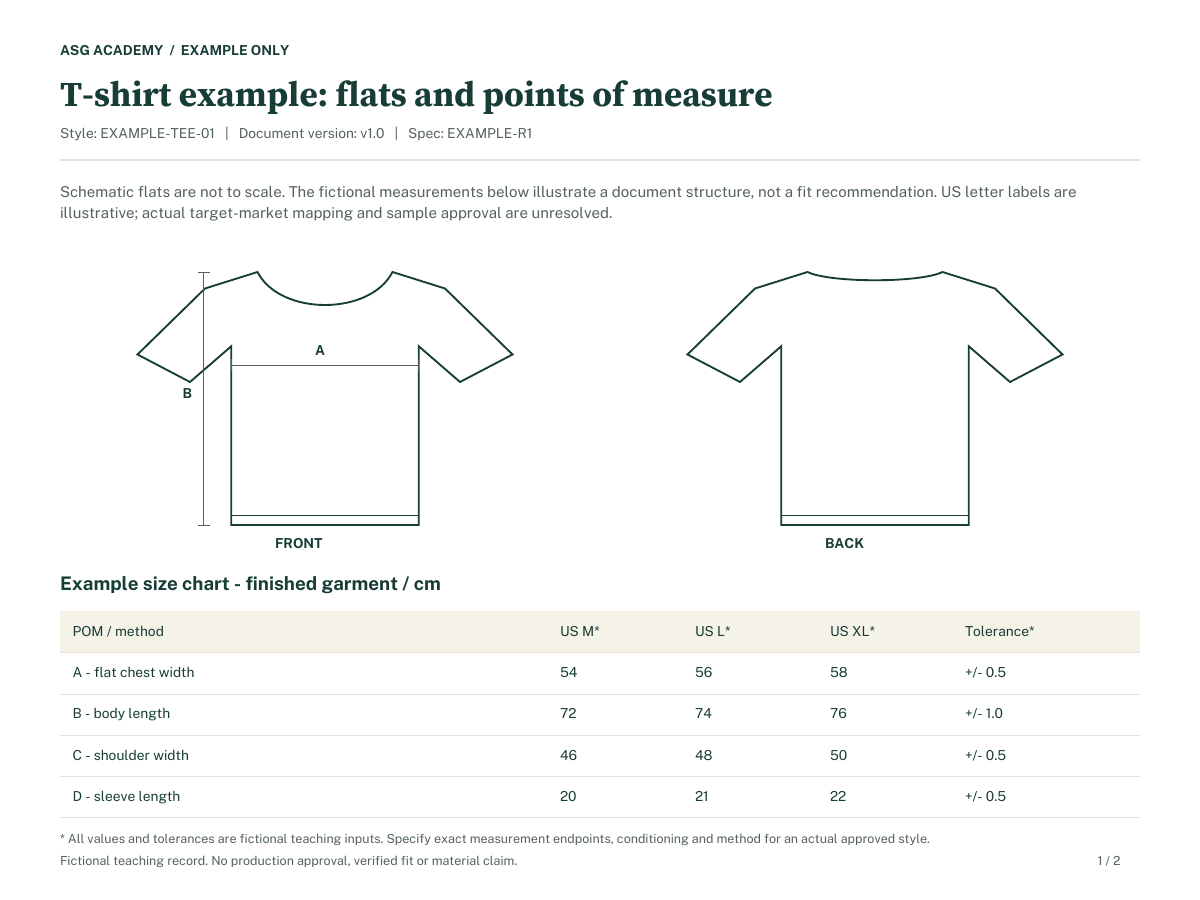
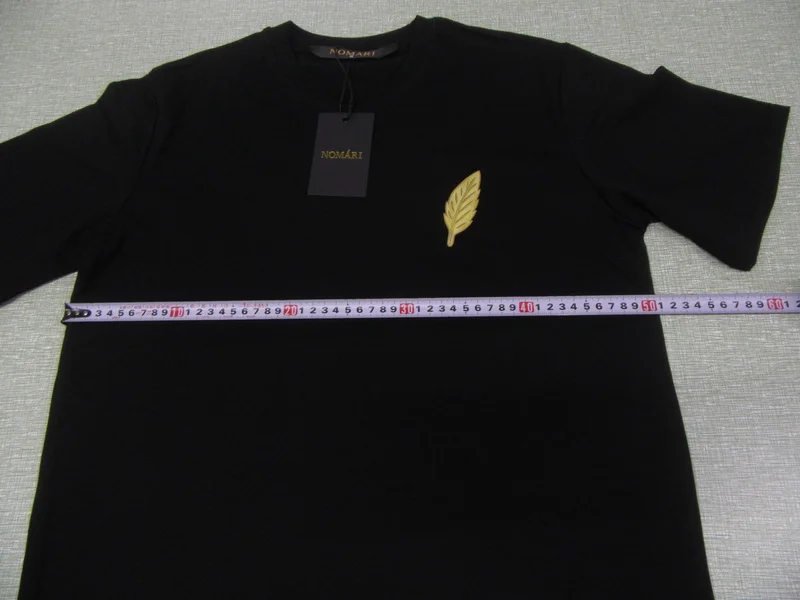
Say how each point is measured, for example flat across the chest, 2 cm below the armhole. The values below are teaching numbers, not a fit standard.
| POM | US M | US L | US XL | Tolerance |
|---|---|---|---|---|
| A · flat chest width | 54 | 56 | 58 | ±0.5 |
| B · body length | 72 | 74 | 76 | ±1.0 |
| C · shoulder width | 46 | 48 | 50 | ±0.5 |
| D · sleeve length | 20 | 21 | 22 | ±0.5 |
For a product that is not clothing, swap the garment fields for material, size, function, finish and packing. Name the exact material grade, such as 304 stainless steel or ABS, not just “metal” or “plastic”, and state any recycled percent with the proof you want.
Give dimensions with units, method and tolerance, and name the finish by texture code or signed sample. List the functions to test, the tests or certificates your market needs and who checks them, plus packing rules and the sample ID.
| Field | What to write | Proof to keep |
|---|---|---|
| Metal grade | The agreed grade, such as 304 or 316 stainless steel | Material spec and mill or test record |
| Plastic and recycled content | PP, PET, ABS or other; recycled percent if needed | Material record and proof of content |
| Size and function | Units, method, tolerances and pass/fail tests | Drawing and test method |
| Texture and finish | Texture code, sample ID and finish rules | Finish reference and signed sample |
| Tests and certificates | What your market needs and who checks it | Market and product requirement list |
| Packing and approval | Protection, labels, marks and sample ID | Signed spec and sample version |
There is no single standard tech pack format; the best one keeps specs clear, complete and under version control. A spreadsheet suits materials and measurements, software adds shared editing and revision tracking, and a technical designer can draw flats, make the pattern and grade sizes.
Cost depends on product complexity, sizes, colors and revision rounds; this page gives no price. ChatGPT can draft a table from your notes, but check every number and term it writes.
| Method | Good for | Watch out for |
|---|---|---|
| Spreadsheet (this template) | Materials, measurements and revisions in one file | You still need real drawings and measurements |
| Tech pack software | Teams that share and track product records | Check features, cost and fit with your workflow |
| Technical designer | Flats, patterns and grading for one product | Agree the scope, files and revision rounds |
This two-page PDF is a filled tech pack for a fictional T-shirt, EXAMPLE-TEE-01, linking flats, size chart, tolerances, materials and open questions. Sizes are teaching numbers; material, color and label choices that need proof are left open on purpose.
Use the tech pack to approve samples: check each sample against the exact revision you sent. Measure each point, check materials, color, stitching, labels and packing, and record your method and the sample’s state.
For each gap, decide to fix, clarify or change the spec, and get sign-off before changing a value. Put the approved sample and signed revision on your PO and inspection brief. A photo or a file called “final” does not prove a sample passed.
| Item | Tech pack says | Sample shows | Decision and sign-off | Revision |
|---|---|---|---|---|
| POM, material, process | The exact spec and reference | Measured result and method | Fix, clarify or approve a change | Revision number |
| Color, label, packing | Swatch code and placement | Photo plus swatch comparison | Reviewer and decision | Signed update |
To approve a golden sample, keep the physical sample, its spec revision and the sign-off together under one ID, and log any later change before production.
how to approve a golden sample
An OEM order needs a complete tech pack, because the factory makes your design. In an ODM order the factory starts from its own design, so write down exactly what changes: materials, sizes, artwork, functions or packing. Keep the base model and your changes in one record linked to the PO and inspection; a catalog photo does not cover every detail.
OEM vs ODMFor private label, put your branding and any product changes in the spec before sampling starts.
private label suppliers that work from your tech packFactories most often misread four fields: tolerances, color codes, size systems and BOM units. Ask the factory to confirm these in its own words, then compare the reply with your spec. At ASG, our Production Monitor stage looks for gaps between the goods and the spec, which needs a clear spec only you can supply. Log any swap the factory proposes and settle it before the next release.
ASG’s published Production Monitor stage →Each POM, its method, unit and allowed range.
Code, system, card edition and swatch.
The size labels and the real measurements.
Amount, unit, size basis and source.
Show the front, back, side and key details of the product. Label each view and keep its version number on it.
List each material and trim with blend, weight, build, color, usage and source. Mark any choice that is still open.
Define each point of measure, the units, the method, the size system and the grade. Give every point a tolerance.
Describe seams, stitches, artwork, label placement and packing. Note any test or market rule someone still needs to check.
Record each change and who approved it. Use the same revision on the PO, the sample and the inspection brief.
A tech pack is the set of documents that tells a factory what to make and how it will be checked. For clothing, it covers flat drawings, materials, measurements, tolerances, construction, labels and packing, plus a revision log. You supply the real details. A blank form or an example is not an approved spec.
It depends on the product. Cost rises with the number of views, materials, sizes, colors and revision rounds, and with pattern and grading work. Compare what each designer or tool delivers. This page gives no price; the free template gives you the fields, not the design work.
Draw the technical views, then fill in the materials and trims. Set the points of measure, sizes and tolerances. Add construction, label and packing notes and a revision log. Check the first sample against it and sign off the result. The example PDF on this page shows how the parts fit together.
Partly. ChatGPT can turn your notes into a draft table or text. It cannot measure a sample, and it can state wrong values with confidence. Check every number, material and term it writes, and replace guesses with real data. OpenAI explains why you should verify its answers →
Include a product ID and revision, flat drawings, a bill of materials, a size chart with tolerances, construction notes, and label and packing rules. Name the size system, units, color codes and the approved sample. Keep a revision log. For other products, use material, size, function and finish fields instead.
The free tech pack template is one Excel workbook with seven tabs, from Cover to Revision Log; the version on the Cover feeds every tab. Pair it with the T-shirt example PDF above. The full template pack comes with the course, The China Side Playbook, open to the waitlist first.
see what the founding course covers