
The quotes describe different jobs.
EXW, FOB and delivered quotes leave different work with you. Compare totals only once the named place and inclusions match.
EXWFOBDDP
To import from China to the USA, agree the trade term, measure the packed cartons, book freight, check the HTS code and duty, prepare the invoice and packing list, file ISF for ocean cargo, then clear customs and book delivery. Each step links to one guide below.

EXW, FOB and delivered quotes leave different work with you. Compare totals only once the named place and inclusions match.
A supplier’s suggested code or an old shipment’s duty bill can mislead you. Check the HTS code, origin and extra tariffs for this entry while you can still change plans.
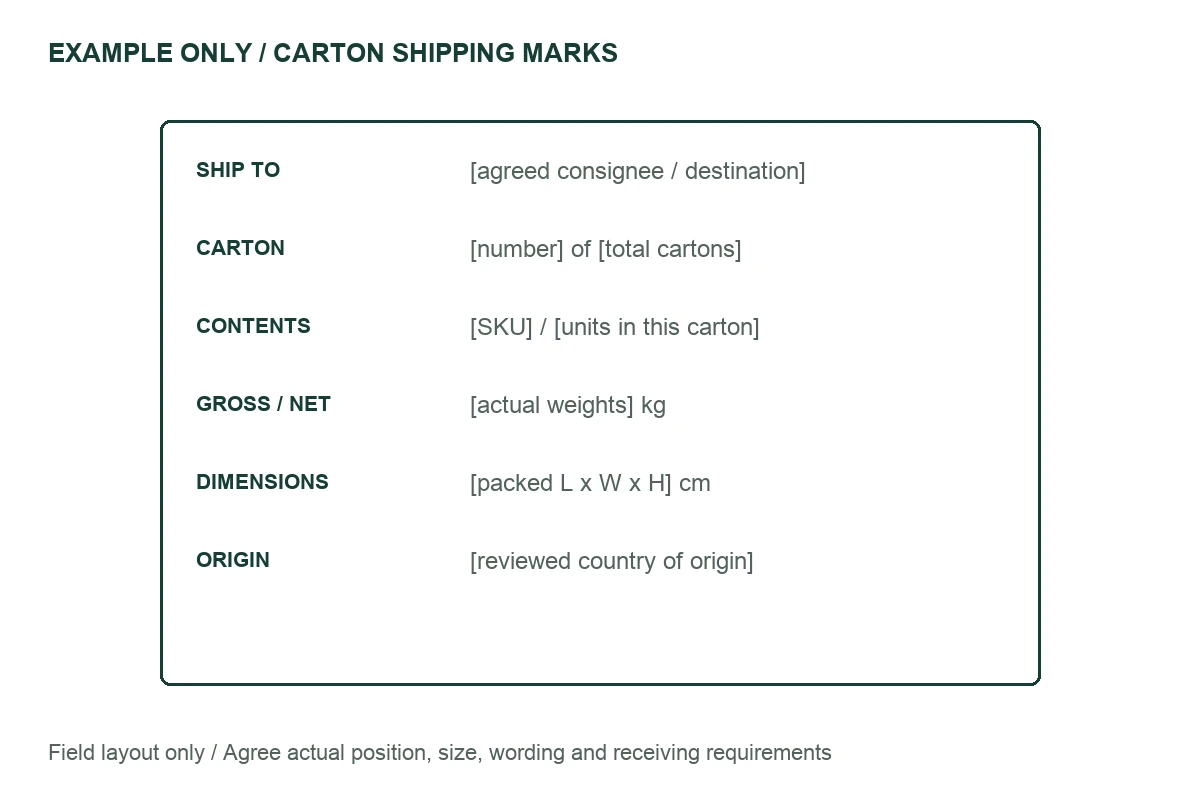
A carton mark, barcode or count that differs from the receiving instructions causes trouble after the goods leave China. Compare the final cartons and papers before pickup.
Importing from China to the USA links five jobs: the purchase terms, the packed carton data, the freight booking, the customs entry and the final delivery. Agree who handles each job, price it from real inputs, keep the documents consistent, and file what customs needs before the goods reach each handoff.
Importing from China to the USA starts with your product and the place it will be received. To learn how to import from China, list which supplier, freight provider, importer and warehouse needs each piece of data. Buying goods and booking freight are linked, but neither covers customs or warehouse receiving.
The supplier confirms what is sold and how it is packed. Buyer and seller agree a trade term with a named place. To quote, the freight provider needs final carton sizes, weights, a cargo description and pickup details. Ask what the quote leaves to you.
The importer and its customs broker need product facts to check the HTS code, value, origin and any extra rules. The commercial papers must describe the real goods and parties. For ocean cargo, the ISF (Importer Security Filing) has its own deadline before loading, so don’t leave it until arrival.
After customs and the carrier release the cargo, delivery still needs an address, an appointment and a way to fix shortages. A customs release, a freight booking and a warehouse receipt are three different events. Keep proof of each handoff with the order.
One guide per decision. Find the missing input, then return to the timeline.
Gather the description, material, function and origin for an HTS code review against the current US tariff schedule before you estimate duty.
hts codeGet freight quotes on the same basis: final carton data, pickup and delivery points, cargo details, scope and validity.
shipping from China to USACompare shared-container (LCL) and full-container (FCL) shipping by handling, quote scope and origin, destination and receiving fees.
LCL shipmentPin down the named delivery point, who acts as importer and who clears customs before you accept a delivered (DDP) price.
DDP shippingTurn your warehouse’s receiving rules into factory steps. Match barcodes, carton marks and counts before goods leave the packing area.
product packaging barcodeConfirm the battery type and whether it is packed with or inside the product. Get a dangerous-goods and carrier review before you pick a route.
un3481Read the parties, cargo description, route and release terms on the bill of lading. Ask the issuer to fix errors before you rely on it.
bill of ladingFind the pickup point and the work left to you, such as loading, export and onward freight, before you compare an EXW quote with a delivered price.
ex worksDefine the freight work you need, and confirm which company handles freight and which handles customs brokerage.
what is a freight forwarderLearn what the entry summary records and what to match against your invoice. Raise any difference with your customs broker.
CBP Form 7501Prepare what a freight provider needs to quote: pickup, delivery, cargo acceptance, inclusions, exclusions and who handles customs.
China forwarder to USAEach step shows who is responsible and what record to prepare. This is an order of work, not a transit schedule.
Keep the approved product, order terms and supplier identity together. A freight enquiry is not a confirmed order.
Write the Incoterms rule, its version, the named place or port and the importer into the order.
Get the receiving rules before the factory packs. Match barcodes, carton marks and counts to the final packing list before dispatch.
Collect the packed outside size, carton count and weights. CBM is length × width × height in metres, times the number of cartons. Mark estimates and give every provider the same data.
Give each provider the same cargo, pickup, destination and service needs. Confirm acceptance, exclusions and schedules before booking; check special cargo, like batteries, first.
Start the HTS review before you buy and recheck it against the final goods. A US HTS code has 10 digits; the first 6 are the shared international HS code. Keep proof for the code, origin and extra tariffs, and never reuse an old shipment’s rate.
Match the commercial invoice and packing list to the real goods, and assign who reviews and files. For ocean cargo, CBP wants the ISF at least 24 hours before the cargo is loaded onto the ship in China. Keep the confirmation.
Track customs holds and carrier holds separately. Confirm release before pickup, book delivery, keep the warehouse receipt and log any shortage with the right provider.
Add the goods price, freight, duty and customs fees, noting each figure’s source and scope, then work out a cost per unit.
landed costEnter the packed outside size and carton count before you ask for freight quotes. Mark estimates and confirm weight rules with your provider.
Return to carton measurement →Prepare both before shipment. Match goods, parties, counts, values and packing, and confirm who files the final versions.
Return to document preparation →Compare quotes only after the shipping duties are split the same way. An Incoterms rule is a standard split of tasks, costs and risk between buyer and seller; Incoterms 2020 has 11 rules. Write down the rule, version and named place, who arranges transport and export and import clearance, and what each quote covers. Name the importer of record on its own line. Incoterms don’t set ownership, payment timing or other contract terms, so keep those in the order.
Open the trade-term task →Official overview: trade termsChoose a shipping mode from your cargo, deadline, value and receiving needs, starting with the final packed size, count and weight. Air freight is billed on the higher of real weight or volume weight. Volume weight is usually length × width × height in cm ÷ 6000 (the IATA standard); couriers often divide by 5000. Declare batteries or other restricted cargo first. Ask for a current quote with route, scope, exclusions and schedule; port-to-port and door-to-door are different services. Posted transit times vary by route and season, so confirm them with your forwarder.
Find the shipping task →
Check the entry rules before the goods move. The product description and origin set the HTS code; extra tariffs and exclusions need their own current check. Confirm origin marking, the ocean ISF and any agency rules for your product. Note a source and date for each assumption, and ask your customs broker to close the gaps. The official links below are starting points, not a tariff ruling or customs approval for your shipment.
| Check and what to keep | Official resource | Resource review date |
|---|---|---|
| HTS classification Keep the material, function and product proof; confirm the code for the final goods. | USITC tariff classification | 18 Oct 2026 · Resource review |
| Additional China measures Check current actions and exclusions for this entry; Section 301 is only part of the tariff picture. | USTR China tariff actions | 18 Oct 2026 · Resource review |
| Origin marking Confirm the origin-marking rules and any exception for your product and its packaging. | CBP origin-marking guidance | 18 Oct 2026 · Resource review |
| Ocean ISF Name the filer and confirm the deadline and data before loading. | CBP ISF guidance | 18 Oct 2026 · Official index reviewed |
| Import licence / agency requirements Find the agencies that cover your goods and confirm any permit, test or other limit. | CBP licences and permits | 18 Oct 2026 · Official index reviewed |
Name the importer of record before you commit to the shipment, even when the offer is DDP. The importer of record is the company legally responsible for the customs entry. Confirm the legal business, who signs off on the entry and which records you will get.
CBP’s guidance for importers says that using a broker does not shift the importer of record’s duty for the entry data, duties, taxes and fees. A customs broker files the entry; the freight provider’s transport service is a different job.
Check whether you need a customs bond and who will arrange it. A supplier’s shipping quote does not settle these questions, so write down the parties and handoff proof before pickup.
CBP guidance for importersConfirm the goods, entry data and charges.
Review and file within the agreed scope.
Find out who provides it and when you need it.
A carton mark, count or packing list that doesn’t match is far easier to fix while the goods are still in China. Keep the approved packing instructions with the goods, and make sure each receiving barcode points to the right product.
At ASG, quality control runs in four stages: Supplier Audit, Production Monitor, Warehouse Check and Pre-Dispatch. The Warehouse Check looks at each incoming batch before it is stored. Agree the inspection scope, pass and fail rules and sampling plan for your own product and order.
Pre-Dispatch is the last look before goods leave: packaging, labels and addresses, with photos of what goes out. Use it to match the goods with pickup and receiving instructions, and log who approved any exception. The packing photo is from our archive, not proof that one shipment passed.
ASG published quality-control process
A seller ships a non-electrical storage product to a US warehouse. The table shows what each step hands over and who needs it. No price, duty rate or transit time is assumed; if the product, origin, packing or delivery scope changes, recheck the record it affects.
| Step | Handoff record | Responsible party |
|---|---|---|
| Agree terms | Order terms, named place and who does what. | Buyer and seller. |
| Confirm cartons | Final sizes, weights, count and packing version. | Supplier or measurer; buyer checks. |
| Prepare volume input | CBM from measured cartons, with estimates marked. | Buyer or freight provider. |
| Confirm shipping scope | Cargo acceptance, quote scope and booking record. | Freight provider and buyer. |
| Review HTS and entry assumptions | Product facts, HTS code and extra-tariff review. | Importer and customs broker. |
| Reconcile documents | Invoice, packing list and filing confirmations. | Supplier, importer and filers. |
| Clear and receive | Release, pickup, delivery and receiving records. | Importer, broker, carrier and warehouse. |
The China Side Playbook links shipping choices to quote inputs, trade terms, documents and the handoff to a forwarder or customs broker. It has six stages and 22 lessons (P01–P22), from the first purchase brief to the next-order decision. Lessons release in order, starting with P01.
Explore the 22-lesson plan
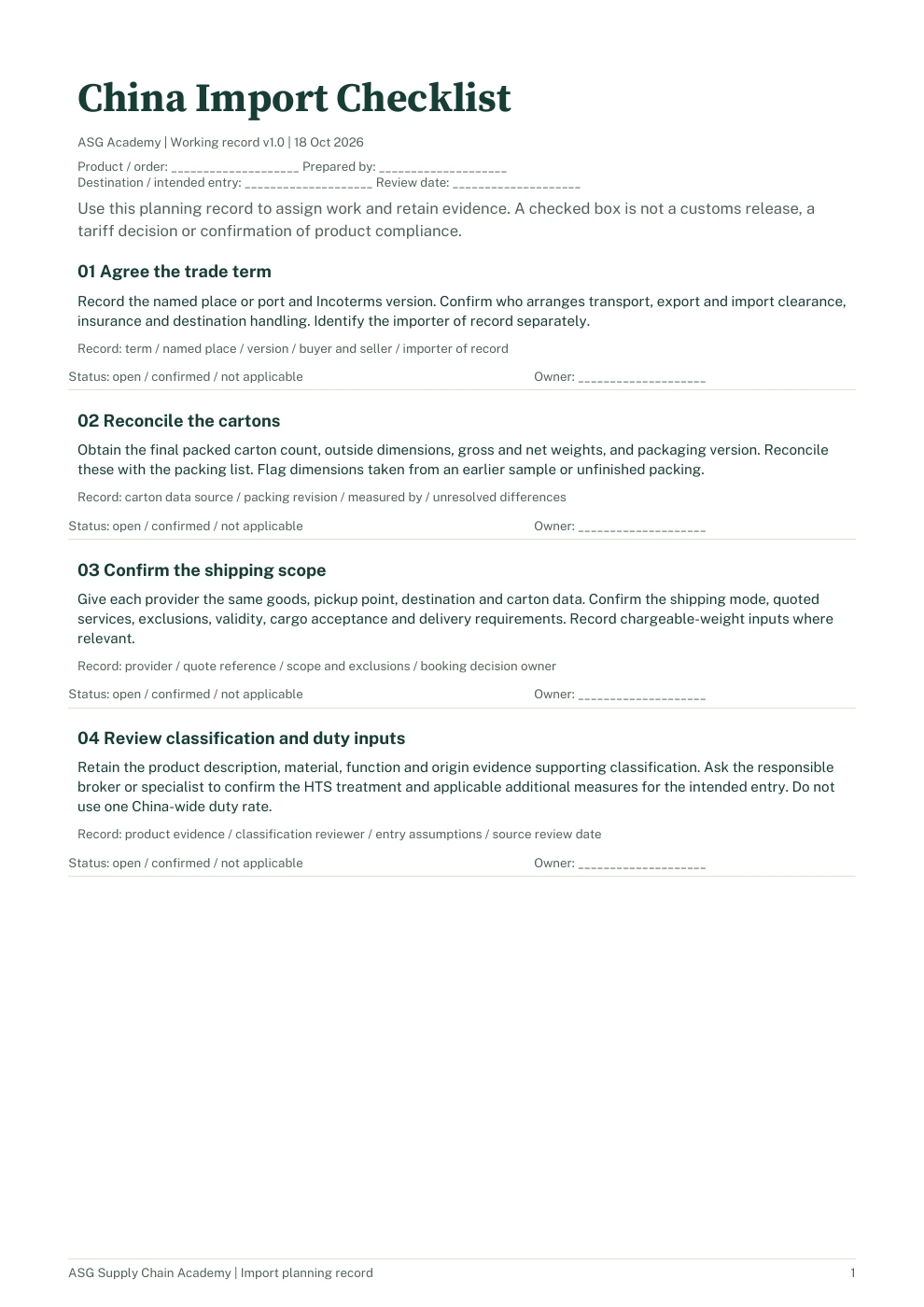
Keep one record for trade terms, final carton data, freight scope, HTS inputs, documents, ocean ISF and the handoff from release to delivery. The two-page checklist has fields for the owner, the status and the proof still needed.
Start with measured packed sizes and the final carton count. Mark estimates and collect weights. These are quote inputs, not a freight price.
Go to this step →Write the Incoterms rule with its version and named place or port. Put the service scope and the importer on their own lines so you compare like with like.
Go to this step →Collect the product’s material, function and origin for your broker, and check extra tariffs for this entry. Never copy an old shipment’s rate.
Go to this step →Bring the goods, freight and entry costs together. Keep each number’s quote scope and date, and note what is included, excluded or missing.
Go to this step →You can order from China through B2B marketplaces like Alibaba.com and 1688, wholesale sites, trade fairs or direct factory contact. Pick the channel that fits your product and order size, then check the supplier and agree the terms.
Most consumer goods can be imported from China, but each product must meet the rules of the US agencies that cover it, such as the CPSC, FDA or FCC. A supplier’s offer to ship does not mean the product can enter the US. Check permits, testing, marking and transport limits before you buy.
There is no fixed price: the total is goods, freight, duty, customs fees and delivery added together. Freight alone for a 1 kg air parcel to the US ran about $18–$27 on most quotes ASG received in October 2026. Divide the real total by units for a per-unit cost.
Yes, in most cases. US duty depends on the HTS code, the origin and any extra tariffs, such as Section 301. Rates change, so check the current USITC tariff schedule and USTR actions, then confirm with your customs broker.
Ask your broker or carrier for the hold reference, the agency involved, the information it wants and who acts next. Paying an estimated duty does not by itself clear a document question or an exam. Get a written breakdown of any exam or extra service fees and who handles them.
Start with the free first lesson, then use the task list to prepare each decision and document.