
What a Bill of Lading Is in Shipping
A bill of lading in shipping is the carrier’s document for goods moving by sea. People write it as B/L or BL. It names the shipper, the consignee and the cargo, and states the carriage terms on the back or by reference.
Two forms matter most. An order B/L (“to order” or “to order of” a bank) is negotiable: whoever holds the endorsed original can claim the cargo. A straight B/L names one consignee and cannot be transferred by endorsement.
A draft B/L is a copy for checking before the carrier issues the final document. It is not the original and it does not release cargo.
Don’t mix this up with a U.S. trucking BOL. That form covers a domestic road move, not ocean title. This page is part of our importing from China guide.

Three Jobs a B/L Does: Receipt, Contract and Title
Receipt of the cargo
The B/L confirms the carrier received a stated number of packages in apparent good order. “Received for shipment” means at the terminal. “Shipped on board” with a date means loaded on the vessel. The carrier counts packages, not what is inside sealed cartons.
Evidence of the carriage contract
The B/L shows the terms the carrier moves your goods under: route, ports and liability rules. It is separate from your sales contract with the supplier. Paying the supplier doesn’t change the carrier’s terms.
Title to the goods
A negotiable original works like a key to the cargo. Whoever holds the endorsed original can collect it. That is why suppliers often keep the original until you pay the balance. A scan or PDF copy does not give you that right.
Original B/L, Telex Release and Sea Waybill
There are three common ways to release ocean cargo: an original B/L, a telex release and a sea waybill. An original B/L is a paper document, often issued as a set of three, and one endorsed original must be handed over at destination. A telex release is when the shipper surrenders the originals at origin, and the carrier tells its destination office to release without paper. A sea waybill is a non-negotiable document with no original to surrender. The named consignee collects the cargo after showing ID.
| Option | Title / transfer function | How release is arranged |
|---|---|---|
| Original B/L | An order B/L is negotiable; a straight B/L is not. | Hand over one endorsed original at destination. |
| Telex / surrender release | Still an original B/L, surrendered at origin. | The carrier confirms release to its destination office. |
| Sea waybill | Non-negotiable; not a document of title. | The named consignee collects with ID. No original needed. |
House B/L vs Master B/L
A house B/L (HBL) is issued by a forwarder acting as NVOCC to you; the master B/L (MBL) is issued by the shipping line to that forwarder.
Which option you pick depends on how much you trust the supplier and how you pay. Related reading: original B/L vs sea waybill vs telex release.
Maersk: surrendering an original B/L →Fields to Check on a Bill of Lading
Check ten fields on every bill of lading draft: shipper, consignee, notify party, ports, vessel, container and seal, marks, packages, gross weight and measurement. Compare each one with your instructions and your packing list, and use the match your packing list for that.
The notify party only receives the arrival notice. It does not get the right to collect the cargo. On a master B/L, the consignee is often the forwarder’s destination agent, while you appear on the house B/L. Check which one you are reading before you ask for changes.
Look at units, not just numbers. “120 CTNS” and “6 PLTS” can describe the same shipment, but the packing list must explain how. Cargo gross weight is also different from the container’s VGM (verified gross mass), which includes the box itself.
| Field | What to record | Comparison document |
|---|---|---|
| Shipper | Usually the supplier, as agreed. | Shipping instructions and contract. |
| Consignee | Your company, or “to order” wording. | Your instructions and any bank terms. |
| Notify party | Who gets the arrival notice. | Your broker or your own contact. |
| Ports / places | Port of loading and discharge, plus receipt and delivery places. | Booking confirmation. |
| Vessel / voyage | Ship name and voyage number. | Latest carrier schedule. |
| Container / seal | Container number and seal number. | Loading record and photos. |
| Marks / package count | Shipping marks, carton range and package type. | Final packing list and carton record. |
| Gross weight | Total weight in kg, packing included. | Packing list and weighing record. |
| Measurement | Volume in cubic metres (CBM). | Packing list carton sizes. |
| Description / dates | Goods description and on-board date. | Commercial invoice and booking. |
Who Issues the Bill of Lading, and When
The bill of lading is issued by the carrier after the cargo is loaded, based on shipping instructions from the shipper or forwarder. The shipping line issues the master B/L. A forwarder acting as an NVOCC (Non-Vessel Operating Common Carrier) issues its own house B/L to you. In the U.S. trade, NVOCCs must be licensed or registered with the FMC.
The usual order is booking, then shipping instructions, then a draft for checking, then loading, then the final B/L. Fix errors at the draft stage. Changes after issue take time and often cost a fee.
Under EXW, you hire the forwarder, so your forwarder usually issues the house B/L. See ex works terms from China and what a freight forwarder does.
FMC: forwarders and NVOCCs →Paying the Balance and Releasing the B/L
Review the copy and draft status
Ask the supplier for a copy of the B/L or the draft. Check parties, packages, weight and the on-board date. Make sure it is your shipment.
Follow the agreed payment milestone
Pay the balance as your contract says, often against the B/L copy. Confirm any new bank details by phone or video first.
Complete the document arrangement
The supplier then asks the carrier for a telex release, or couriers the originals to you. Ask for the carrier’s release confirmation, not just the supplier’s word.
Confirm destination collection
At the destination, you or your broker get a delivery order. Customs clearance, local charges and any terminal holds must also be cleared before pickup.

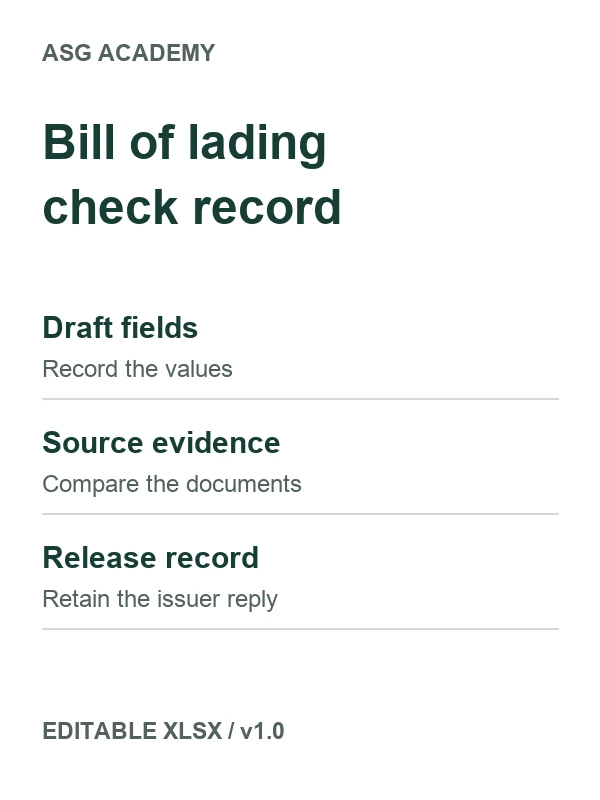
Bill of Lading Template: Use It to Check, Not to Issue
This bill of lading template is a checklist for the draft your forwarder sends you, not a form for issuing a B/L. Only a carrier or NVOCC can issue one. Enter the draft values, compare them with your documents and log each correction. Track payment, telex release and holds as separate steps.
Common Bill of Lading Mistakes on China Shipments
The four most common bill of lading mistakes on China shipments are a wrong consignee, a package count that doesn’t match, missing shipping marks and paying in full before the release is confirmed. Each one can leave cargo waiting at port.
A forwarder named as consignee is not always a mistake. On a master B/L, the forwarder’s agent is often the consignee by design. Check whether you are reading the house or master B/L before you change it.
Paying the balance before release is normal under many contracts. The mistake is assuming payment means release. Keep the payment, the release request and the carrier’s confirmation as three separate items until your broker confirms pickup.
| Issue | Possible consequence | Next check |
|---|---|---|
| Wrong consignee or order wording | The cargo is released to the wrong party, or not at all. | Check HBL vs MBL and your instructions. |
| Package type or count differs | Customs or the carrier query the shipment. | Reconcile cartons, pallets and units. |
| Missing or outdated marks | Cartons can’t be matched to the documents. | Compare carton photos with the packing list. |
| Payment assumed to mean release | Cargo sits at port while storage fees build. | Get the carrier’s release confirmation. |
Match Cartons to the B/L Before Loading
Match the cartons to the B/L details before the container is loaded, because fixing the count afterwards is slow and costly. At ASG, this happens in the Pre-Dispatch stage, the last of our four QC stages: Supplier Audit, Production Monitor, Warehouse Check and Pre-Dispatch.
In our Shenzhen and Dongguan warehouses, we count the cartons, check the shipping marks and carton range, and confirm that packaging and labels are right. We photograph the cartons and send the final packing list to the forwarder for the shipping instructions.
If the container is loaded at your supplier or a consolidation warehouse, ask for the container and seal numbers. Send them to the forwarder so the B/L draft matches what was really loaded.


Questions About Bills of Lading
What is a bill of lading in logistics?
A bill of lading is the carrier’s document for cargo: a receipt for the goods, evidence of the shipping contract and, in negotiable form, title to the goods. In ocean freight, it controls who can collect the cargo. A draft copy is for checking only and does not release anything.
What is a telex release for a bill of lading?
A telex release lets cargo be released at destination without the paper original. The shipper surrenders the originals at origin, and the carrier sends a release message to its destination office. It usually follows payment of the balance. Ask for the carrier’s confirmation, not just the supplier’s word.
Who prepares the bill of lading?
The carrier prepares and issues the bill of lading, using shipping instructions from the shipper or forwarder. The shipping line issues the master B/L. A forwarder acting as NVOCC issues its own house B/L. You check the draft and ask for corrections before it is issued.
What are the three types of BL?
The three types most guides name are straight, order and bearer bills of lading. A straight B/L names one consignee and is not negotiable. An order B/L is negotiable by endorsement. A bearer B/L goes to whoever holds it and is rarely used. Telex release and sea waybills are release methods, not B/L types.
Who pays for a bill of lading?
Origin document fees, including the B/L fee, are usually paid at origin by the shipper. Under FOB the supplier usually pays them even though you book the freight; under EXW you do. Destination fees, such as the delivery order fee, are paid by the consignee. Confirm every charge and payer in writing with your forwarder.