
What UN3481 Means
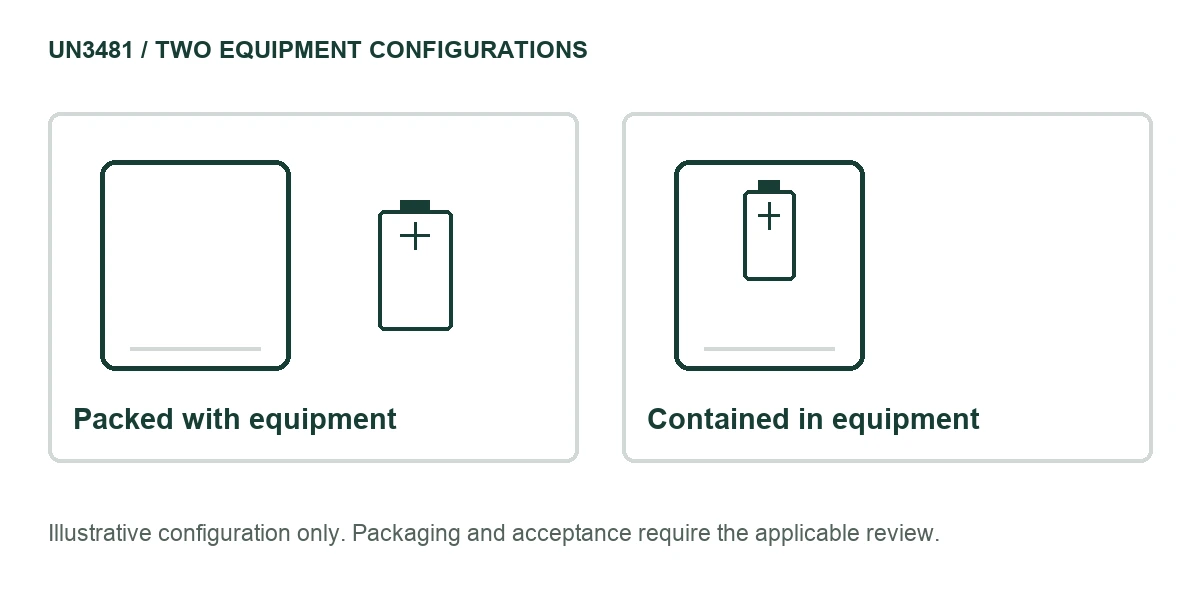
UN3481 is the UN number for lithium-ion batteries that travel with the device they power. It has two forms. “Packed with equipment” means the battery is in the same box as the device but not fitted inside it, like a drill with a loose battery pack. “Contained in equipment” means the battery is installed, like a phone or a wireless earbud case.
A UN number is a four-digit code the United Nations gives to each dangerous good, so every carrier reads it the same way. Lithium batteries fall in Class 9, miscellaneous dangerous goods.
To use UN 3481, confirm three facts: the chemistry is lithium-ion, the device is in the box, and whether the battery is fitted or loose. A photo of a sealed retail box can’t show that. Ask the supplier for the battery spec and an open-box photo. This guide is part of our how to import from China series.
UN3480: Lithium-Ion Batteries Shipped on Their Own
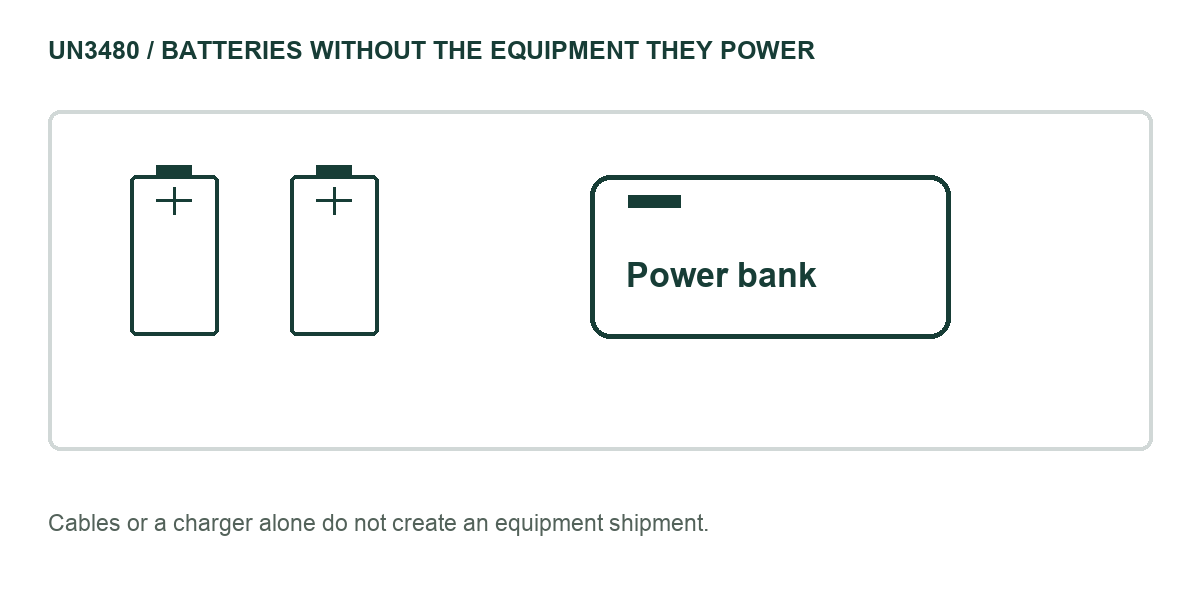
UN3480 is the UN number for lithium-ion batteries shipped on their own, with no device in the box. Spare batteries and power banks are the common cases. A power bank counts as a battery, not a device. Adding a cable to the box does not change that.
By air, UN3480 is the hardest of the three to ship. It falls under IATA Packing Instruction 965. It is banned on passenger aircraft and must fly on cargo aircraft only. The battery must also be at no more than 30% state of charge.
So don’t call a power bank a charger or an accessory to get a cheaper service. The goods themselves decide the number. Rules on cell size and packing sections sit in the current IATA DGR.
UN3480 vs UN3481: Which One Applies to Your Product
Which UN number applies depends on two questions: is the battery lithium-ion or lithium-metal, and is it alone, packed with a device, or installed in one? Those answers give you one of six IATA packing instructions, PI 965 to PI 970. A packing instruction is the IATA rule that sets the box, limits, marks and papers for that kind of battery.
Packing instructions 966, 967, 969 and 970 split into sections; PI 965 and 968, for batteries shipped on their own, no longer have a Section II. Section II covers small batteries and is lighter on paperwork. For lithium-ion, that usually means up to 100 Wh per battery and 20 Wh per cell. For lithium-metal, it means up to 2 g of lithium per battery and 1 g per cell. Bigger batteries are fully regulated under Section I. The limits per package and the 2026 charge rules sit in the current DGR.
| Product situation | UN number | Air packing-instruction entry | Illustrative product |
|---|---|---|---|
| Lithium-ion battery shipped on its own | UN3480 | PI 965. Cargo aircraft only; 30% charge cap. | Spare battery or power bank |
| Lithium-ion battery packed with its device, not installed | UN3481 | PI 966 | Drill with a loose battery pack in the box |
| Lithium-ion battery installed in the device | UN3481 | PI 967 | Phone, tablet or speaker |
| Lithium-metal battery shipped on its own | UN3090 | PI 968. Cargo aircraft only. | Spare coin cells |
| Lithium-metal battery packed with its device | UN3091 | PI 969 | Remote with loose coin cells in the box |
| Lithium-metal battery installed in the device | UN3091 | PI 970 | Watch or tracker with a fitted cell |
| Chemistry or setup unclear | Not yet known | Get the facts before you pick a row. | Unlabelled battery or e-bike |
These limits follow IATA 2026 guidance (DGR 67th edition). E-bikes and damaged batteries follow other rules.
IATA: lithium-ion packing-instruction overview →IATA: 2026 charge-condition changes →Documents a Forwarder Will Ask For
A forwarder will ask for four things before booking battery cargo: the UN 38.3 test summary, the battery spec, the packing setup and, if they request it, an SDS. The UN 38.3 test summary is a short report showing the battery model passed the UN transport tests, such as altitude, heat, shock and short circuit. It must match your model number.
An SDS (safety data sheet, once called an MSDS) describes chemical hazards. IATA says it is not a required transport document for batteries, but many forwarders still ask for one. Fully regulated Section I cargo also needs a Shipper’s Declaration for Dangerous Goods, signed by a trained person.
Tick the boxes below as you gather each record. Your ticks stay on this page only.
| Record noted | Who provides it | When needed | Verification source / detail |
|---|---|---|---|
| Battery maker or distributor | Before you book. Match the model number. | Proves the battery passed the UN transport tests. PHMSA: lithium batteries and test summaries → | |
| Supplier | Before the forwarder picks a service. | Chemistry, Wh rating, cell count, charge level and packing. | |
| Supplier | When the forwarder or carrier asks. | Safety data, not transport proof. Not a stand-in for UN 38.3. | |
| Shipper, forwarder or trained reviewer | Before booking and again at handover. | Shipper’s Declaration for Section I; marks and statements for Section II. |
0 of 4 records noted.
Lithium Battery Labels and Marks on Cartons
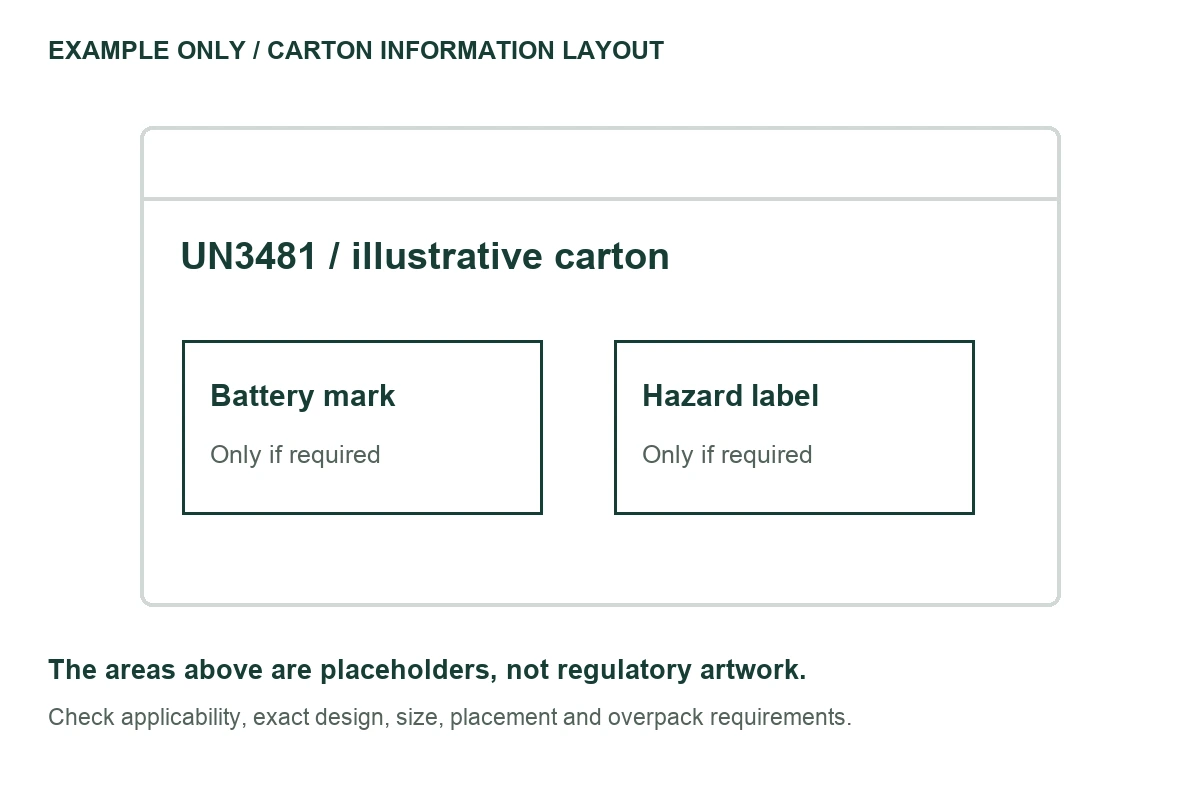
Battery cartons carry two different symbols, and you need to know which one applies. The lithium battery mark is a rectangle with a red hatched border, a battery picture and the UN number. Section II packages usually need it. The Class 9 lithium battery hazard label is a diamond with black stripes on the top half and a battery picture below. Section I packages need it.
UN3480 and UN3090 cartons going by air also carry a “Cargo Aircraft Only” label. The UN numbers on the marks must match the documents and the booking. Keep marks clear of tape, straps and other labels.
Your normal shipping marks and barcodes go on the carton as well, but they do a different job. See carton marks and labels for how to lay them out without covering the battery marks. Sizes and artwork follow the current IATA DGR or IMDG Code.
Air, Sea or Express: How to Ship Lithium Batteries from China
Air, sea and express all carry lithium batteries from China, but each runs on different rules and needs carrier approval first. Air cargo follows the IATA Dangerous Goods Regulations. Sea freight follows the IMDG Code, where Amendment 42-24 has been mandatory since 1 January 2026. Express carriers add their own account and route rules on top.
Batteries installed in devices are the easiest to ship by any mode. Standalone batteries (UN3480) are the hardest by air, because only cargo aircraft take them. Many sellers send power banks by sea for that reason.
Tell the forwarder the chemistry, model, Wh rating, counts and setup before you ask for a price. Get the carrier’s answer in writing. For the wider picture, see shipping methods from China.
| Channel | Acceptance | Record to prepare | Conditions to check |
|---|---|---|---|
| Air cargo | Airline approval needed | Battery specs, UN 38.3 summary and air papers. | IATA DGR, airline rules, cargo-only limits and charge level. |
| Sea freight | Shipping line approval needed | Battery specs, packing details and IMDG papers. | IMDG Code, line rules and the truck legs at each end. |
| Express service | Account and service approval needed | Exact product, package and document details. | Every leg of the route, service limits and account terms. |
What Battery Parcels Cost: ASG Rate Snapshot, October 2026
A 1 kg air parcel with batteries installed in the device costs about $21–$30 to the US on most quotes ASG received in October 2026, against $18–$27 for general goods. Only some dedicated lines take battery goods, so you have fewer quotes to choose from.
| Parcel weight | General goods (most quotes) | Battery goods (most quotes) | Typical battery premium |
|---|---|---|---|
| 0.5 kg | $11–$18 | $12–$20 | $2 |
| 1 kg | $18–$27 | $21–$30 | $3 |
| 2 kg | $31–$46 | $36–$53 | $4 |
ASG rate snapshot: base air parcel freight from the rate cards eight China logistics providers quote to ASG, effective 19 October 2026, converted at the dated reference rate of 6.69 CNY per USD (2026-10-22), not a live exchange rate. “Most quotes” is the middle half of all quotes for that weight. Remote-area fees, duty and import tax are extra. Your own quotes will differ by product, volume and date.
IMO: IMDG Code and mandatory amendment →FedEx: battery guidance and destination acceptability contact →Battery Checks Before Cargo Leaves China
The last check before battery cargo leaves China is a pre-dispatch check: packaging, labels and papers checked against the booking. Whoever packs the goods, whether the factory, an agent or a warehouse, should run it. Pre-Dispatch is also the last of ASG’s four published QC stages.
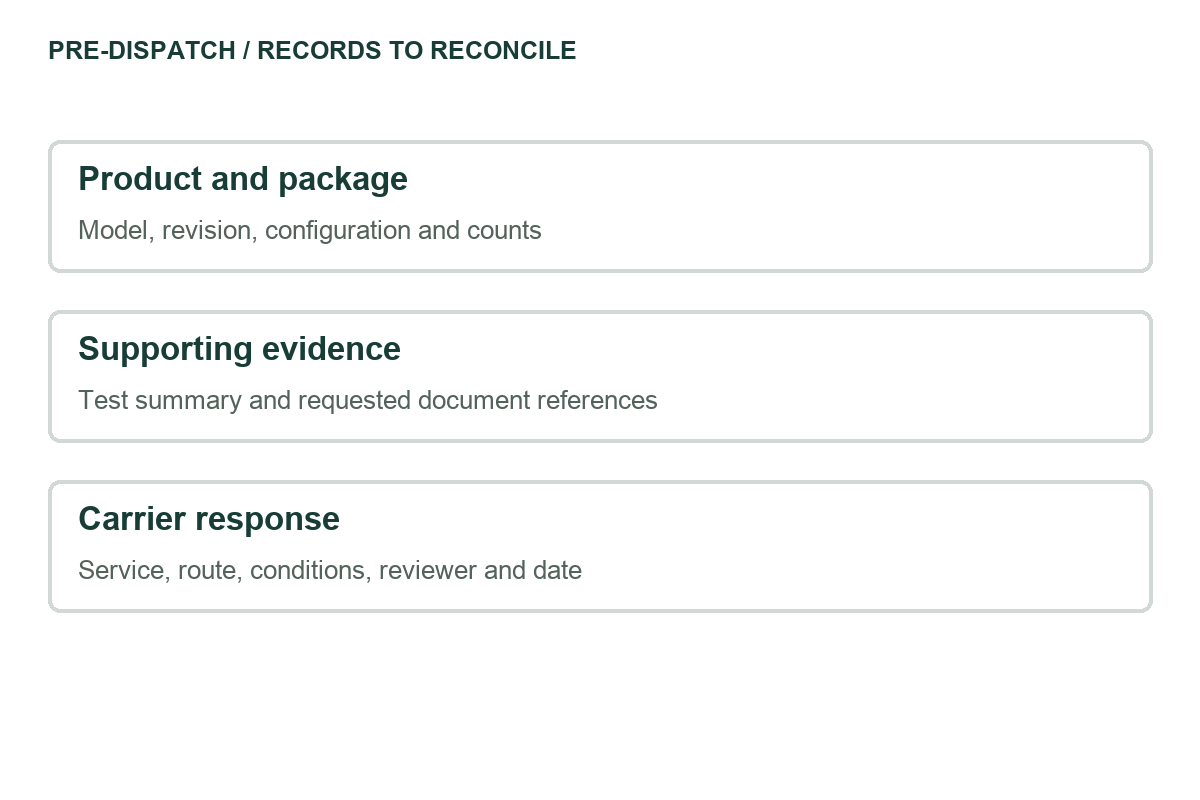
At this check, open a sample carton and confirm the battery setup matches the booking. Check that the UN number and marks match the documents, and that nothing covers them. Photograph each carton face and file the photos with the test summary.
This check catches gaps before the forwarder does. It does not replace the carrier’s decision or the trained person who signs a Shipper’s Declaration.
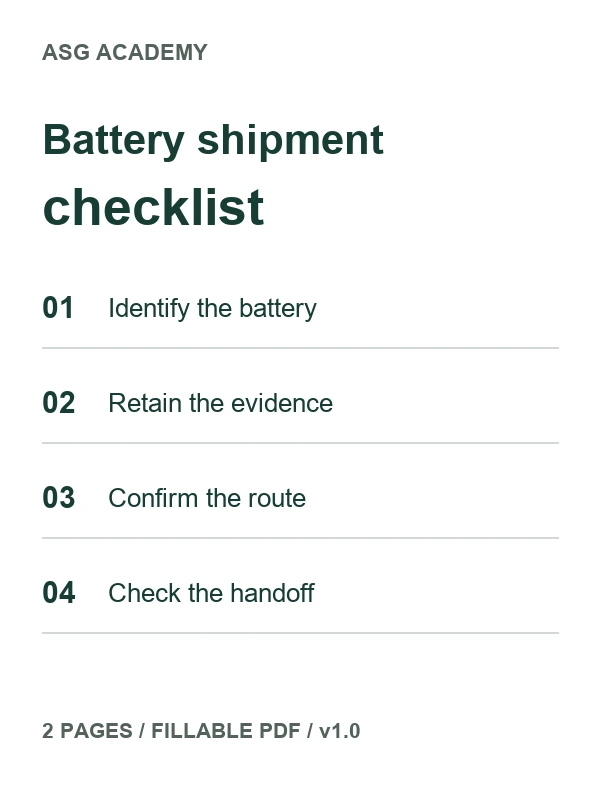
Download the Battery Shipment Checklist
The battery shipment checklist puts everything on two pages: battery facts, documents, UN number, route, carrier conditions and the final carton check. Fill it on screen or print it. Missing items stay visible, so you fix them before booking, not at the airport.
Before You Book: 5 Steps
Confirm the battery type and rating
Find the chemistry, model, Wh rating (volts × amp-hours), cell count and charge level. Note whether it ships alone, packed with or inside the device.
Request the matching evidence
Ask the factory for the UN 38.3 test summary and spec sheet for that exact model. Get an SDS too, since many forwarders ask for one.
Review the UN number and packing entry
Use the table above to pick the UN number and packing instruction. Then check the section against the Wh limits. Don’t let a sales name change the category.
Disclose the goods and confirm the service
Send the forwarder the full record before you ask for a price. Our China forwarder to USA page lists the details to put in a quote request, batteries included. A quote is not an approval.
Reconcile the package before handoff
Before pickup, check that cartons, marks and papers match the approved booking. Photograph each carton. Fix any gap before the truck arrives.
Questions About UN3481 and UN3480
What does UN3481 mean on a battery label?
UN3481 on a label means the box holds lithium-ion batteries packed with or installed in equipment. It tells carriers how to handle the carton. The label alone doesn’t show which form or section applies, so the documents must match it. A printed number is not proof the carton was packed correctly.
What is the difference between UN3480 and UN3481?
UN3480 is lithium-ion batteries shipped alone; UN3481 is lithium-ion batteries packed with or installed in a device. By air, UN3480 uses PI 965 and flies on cargo aircraft only. UN3481 uses PI 966 or PI 967. A power bank is UN3480, even with a cable in the box.
Can UN3481 be shipped by air?
Yes, UN3481 can be shipped by air if it meets PI 966 or PI 967 and the airline accepts it. You need the Wh rating, cell count, UN 38.3 summary and the right marks. Large batteries under Section I also need a Shipper’s Declaration. Get the airline’s approval in writing first.
Which carriers will ship lithium batteries?
Most major airlines, shipping lines and express carriers ship lithium batteries, but each sets its own terms. Approval depends on the battery, setup, route and your account. There is no single list that covers every shipment. Send your forwarder the full battery record and get the carrier’s answer in writing.
Are all lithium batteries considered hazmat?
Yes, lithium batteries are Class 9 dangerous goods (hazmat) in transport. Small batteries can qualify for lighter rules, but that relief does not make them ordinary cargo. PHMSA interpretation 25-0012 confirms this for U.S. ground shipping. Check the IATA DGR or IMDG Code for international legs.
Do lithium batteries have to be shipped in a box?
Yes, in nearly all cases lithium batteries need a strong outer box, with terminals protected against short circuit. Most Section I cargo needs UN-specification packaging. Batteries installed in a device can rely on the device for some protection. Check the packing instruction for your exact setup. The diagrams here are not packing instructions.