What Is a Freight Forwarder?
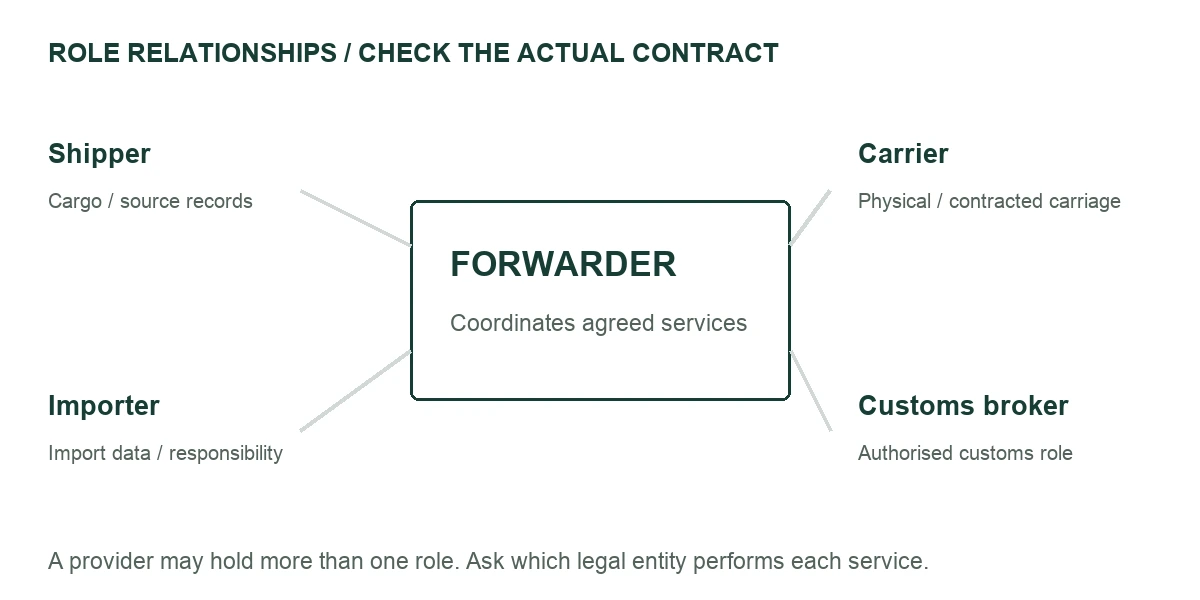
A freight forwarder is a company that organizes the movement of goods for a shipper, using carriers such as shipping lines, airlines and trucking firms. So what does freight forwarder mean for you as an importer? One company plans the route and coordinates the parties, while others do the carrying.
A forwarder need not own trucks, ships or planes. Large groups often run forwarding, customs brokerage and warehousing as separate legal companies, so ask which one you contract with for each service.
Give every forwarder the same facts: carton count, size, gross weight, pickup address, destination and ready date. Then check what each quote leaves out.
This guide is part of our series on how to import from China.
What a Freight Forwarder Does on a China Import
On a China import, a freight forwarder does five main jobs: booking, pickup, export customs, documents and arrival coordination. The exact list depends on what you agree.
Booking
The forwarder books space with a carrier for your route and date. Give it your cargo details and ready date. Ask for the carrier, the cutoff dates and how long the quote is valid.
Pickup and consolidation
It collects cartons from the factory, or from several suppliers into one warehouse. Ask who signs for the cartons and what happens if counts don’t match.
Export customs in China
It arranges the China export declaration through a licensed customs broker. Ask who will be named as exporter and which papers the factory must send.
Transport documents
It drafts or collects the bill of lading or air waybill. Ask who issues it, who checks the draft and how the goods will be released.
Arrival and US customs
It sends arrival notices and works with the US customs broker and the last-mile trucker. An arrival notice does not mean the goods are cleared.

Freight Forwarder vs Carrier vs Courier
A carrier moves the goods; a forwarder arranges the move; a courier does both for small parcels, door to door under one waybill.
Responsibility for the goods depends on the contract and transport document, not on who owns the vehicle. For any claim, check which company issued your bill of lading or waybill, and on what terms.
| Role | Owns the transport? | Transport document | Example |
|---|---|---|---|
| Freight forwarder | Usually not. It buys space from carriers. | Its own house bill (as an NVOCC) or the carrier’s document. | Arranges sea or air freight for you. |
| Carrier | Yes. It operates the ships, planes or trucks. | The master bill of lading or air waybill. | A shipping line or airline. |
| Courier | Yes, through its own express network. | Its own express waybill. | An express parcel service. |
| NVOCC | No. It acts as a carrier without owning vessels. | Its own house bill of lading. | A forwarder that issues its own ocean bills. |
Forwarder or Customs Broker?
A customs broker files your US import entry; a forwarder arranges the transport. Many forwarders own a brokerage or work with one. Brokers are licensed by CBP, and using one does not shift your legal duties as the importer. Read more on customs broker vs freight forwarder.
CBP: customs brokers and importer responsibility →Licenses: NVOCC and OTI in the US
In US ocean trade, the Federal Maritime Commission (FMC) licenses Ocean Transportation Intermediaries (OTIs). There are two kinds: ocean freight forwarders and NVOCCs. A US-based OTI needs an FMC license and a bond. An NVOCC based outside the US can register with the FMC instead.
An NVOCC (non-vessel-operating common carrier) acts as an ocean carrier without owning ships. It issues its own house bill of lading. See what an NVOCC is and how it differs from a forwarder.
This rule covers US ocean shipping only. To check a company, search its exact legal name in the FMC lookup below and note the date.
Documents a Forwarder Handles
A forwarder handles the documents that move with your goods: the bill of lading, the commercial invoice, the packing list, the export papers and the arrival notice. It does not create them all (the seller issues the invoice), but it checks that they match.
For a bill of lading, ask who issues it and how the goods will be released. Keep one list of each document with its version, issuer and checker.
| Document | Who issues it | What the forwarder does |
|---|---|---|
| House bill of lading | The forwarder, acting as an NVOCC. | Drafts it and gets your approval. |
| Master bill of lading | The shipping line. | Books it and passes on the details. |
| Commercial invoice | The seller. | Passes it on and flags mismatches. |
| Packing list | The seller or packer. | Checks counts, weights and sizes. |
| Export declaration | The exporter, through a customs broker. | Collects the papers and arranges filing. |
| Arrival notice | The carrier, NVOCC or destination agent. | Sends it to you and your broker. |
How to Evaluate a Freight Forwarder for China Shipments
To evaluate a freight forwarder for China shipments, send each candidate the same cargo details and scope. Then compare their answers on six points: China coverage, price and scope, documents, problem handling, tracking and legal company. Clear handoffs and a named contact for problems matter more than a smooth tracking page.
Ask for proof behind each answer, and log any missing answer with a name and date. DHL Global Forwarding, Kuehne+Nagel and Flexport are well-known forwarders; naming them is not a ranking or an endorsement.
| Point | Ask | Proof to look for |
|---|---|---|
| China coverage | Who picks up at my factory’s address? | Named local contacts and written receiving rules. |
| Price and scope | What is included at each end? | An itemized, dated quote with exclusions. |
| Documents | Who issues and checks each document? | A named issuer and a sample draft. |
| Problems | Who handles delays, damage or missing papers? | A named contact and the claims terms. |
| Tracking | Which updates will I get, and from whom? | A sample tracking report. |
| Legal company | Which company signs the contract? | Its name, and its FMC record for US ocean freight. |
When You Want Shipping Handled from the Factory
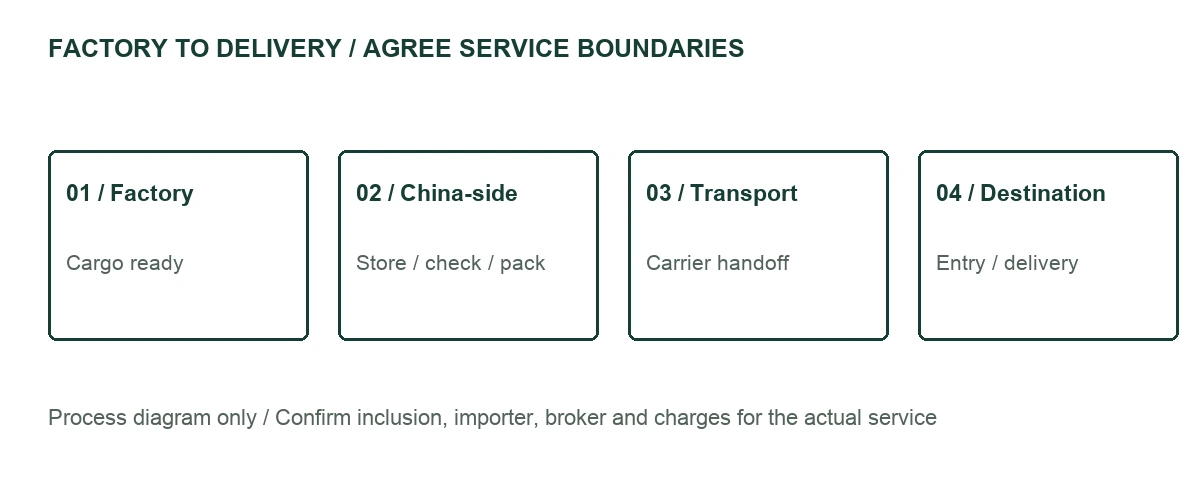
If you want shipping handled from the factory, plan the China-side work before you book freight: storage, checks, packing and dispatch, each with a clear handoff.
At ASG, our warehousing service covers Storage, Picking, QC, Packing, Dispatch and Returns from warehouses in Shenzhen and Dongguan. Our site also describes tax-inclusive customs; for your shipment, ask which company acts as importer and what the tax line covers. See our China forwarder to USA page.


Download the Forwarder Evaluation Checklist
Compare forwarders on scope, documents, problem handling and the contracting company. The checklist has the questions to ask, a handoff log and links to the official FMC and CBP pages.
Questions About Freight Forwarders
What exactly does a freight forwarder do?
A freight forwarder arranges your shipment from start to finish. It books space with carriers, collects the goods, handles export papers and the bill of lading, and coordinates arrival and customs. The exact scope depends on your agreement, so get it in writing.
What’s the difference between a freight forwarder and a carrier?
A carrier physically moves the goods; a freight forwarder arranges the move. Shipping lines and airlines are carriers. A forwarder buys space from them. An NVOCC sits in between: it issues its own bill of lading without owning ships.
Is a freight forwarder the same as a shipping company?
Not always. “Shipping company” can mean a shipping line that owns vessels, or any firm that arranges shipping. A freight forwarder arranges; it usually doesn’t own the ships. Check the company name on your transport document.
Is DHL a freight forwarder?
Yes. DHL Global Forwarding is the DHL Group division that provides air and ocean freight forwarding. DHL Express, the courier business, is a separate division. Check which DHL company is on your quote and contract.
Do you need a license to be a freight forwarder?
In US ocean shipping, yes. A US-based ocean freight forwarder or NVOCC needs an FMC license and a bond. Foreign NVOCCs can register instead. Rules differ in other countries and for air freight. Check the FMC licensing page: FMC: licensing and foreign registration →