
Shipping from China to the US in Four Decisions
Shipping from China to the US is a chain of handoffs, and four decisions shape the cost and time of every one. This page is part of the full China import guide.
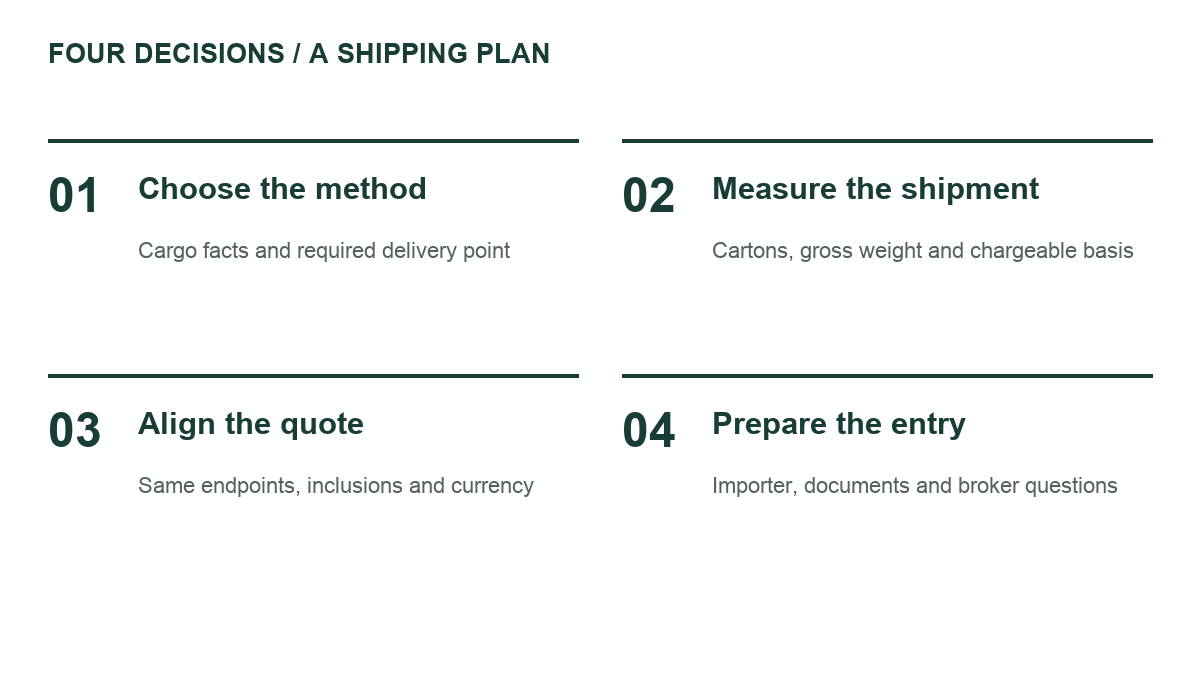
Fit the method to the cargo
Pick express, air, LCL or FCL based on size, weight, value and how fast you need the goods. Check the route and any cargo limits first.
Use the packed carton specs
Record carton count, outside sizes and gross weight. A per-kilo rate means nothing until you know how the forwarder works out chargeable weight.
Name the same start and end
Write down pickup point, delivery point, trade term, currency and what is included. A port-to-port price and a door-to-door price answer different questions.
Prepare the entry early
Know who is the importer of record and who files the entry. Gather product facts and documents while the goods are still in China.
Choose a Shipping Method: Express, Air Freight, LCL or FCL
There are four ways to ship goods from China to the US: express, air freight, LCL sea freight and FCL sea freight. Express (DHL, FedEx, UPS) is fastest and handles customs for you, but costs the most per kilo. Air freight is cheaper per kilo at volume and needs a broker and a delivery truck at the U.S. end. LCL (less than container load) shares a container with other shippers. FCL (full container load) gives you the whole box.
Choose from the goods outward: size, weight, value and deadline. Ask each forwarder to quote the same cargo and name the origin port, such as Yantian, Ningbo or Shanghai. Ports are not interchangeable: the truck move from your factory changes too.
| Method | Cargo fit | Transit estimate | Billing basis | Check closely |
|---|---|---|---|---|
| Express | Samples and small cartons, roughly under 100 kg. | About 3–7 days door to door. | Greater of actual or volume weight; divisor often 5000. | Surcharges, remote-area fees and cargo limits. |
| Air freight | Time-sensitive cargo, often 100 kg and up. | About 5–10 days door to door. | Chargeable weight; IATA divisor 6000. | Airport handling and U.S. delivery left out. |
| LCL | Too much for air but well under a full container. | Add about 1–2 weeks to the FCL range for consolidation and unpacking (typical; confirm with your forwarder). | Per CBM or per tonne, whichever is higher (W/M). | Consolidation fees, destination charges and minimums. |
| FCL | Usually about 15 CBM or more, in your own container. | About 14–20 days port to port (West Coast); 25–40 (East Coast). | Per container, plus local charges. | Free time, VGM, cut-offs and drayage. |
What a Small Parcel Costs: ASG Rate Snapshot, October 2026
A 1 kg general-goods air parcel from China to the US costs about $18–$27 in base freight on most quotes ASG received in October 2026. A 0.5 kg parcel runs about $11–$18 and a 2 kg parcel about $31–$46. Battery goods cost a few dollars more per parcel.
| Parcel weight | General goods (most quotes) | Battery goods (most quotes) | Typical battery premium |
|---|---|---|---|
| 0.5 kg | $11–$18 | $12–$20 | $2 |
| 1 kg | $18–$27 | $21–$30 | $3 |
| 2 kg | $31–$46 | $36–$53 | $4 |
ASG rate snapshot: base air parcel freight from the rate cards eight China logistics providers quote to ASG, effective 19 October 2026, converted at the dated reference rate of 6.69 CNY per USD (2026-10-22), not a live exchange rate. “Most quotes” is the middle half of all quotes for that weight. Remote-area fees, duty and import tax are extra. Your own quotes will differ by product, volume and date.
To decide between the two sea options, read LCL vs FCL. Battery products need their own packing, labels and declarations; see shipping lithium batteries from China.
Air Waybill (AWB) vs Bill of Lading
An air waybill (AWB) is the non-negotiable transport document for air cargo; it is a receipt and contract, but not title to the goods. Sea freight uses a bill of lading instead. Learn how a bill of lading works. Related reading: HAWB vs MAWB on air shipments.
Related reading on picking a port: which China sea port to ship from.
Maersk: air waybill functions →
Estimate Volume and Chargeable Weight Before You Ask for Quotes
Before you ask for quotes, work out the total CBM and the chargeable weight of your packed cartons. CBM (cubic metres) is length × width × height in centimetres, divided by 1,000,000. For a 60 × 40 × 40 cm carton, that is 0.096 CBM. Multiply by the number of cartons.
Air and express bill on chargeable weight. That is the higher of the gross weight and the dimensional weight. Dimensional weight is L × W × H in cm divided by a divisor. IATA air cargo uses 6000. Express carriers often use 5000, which makes bulky boxes cost more. Ask each provider for its divisor and rounding.
For a full container, the shipper must declare the VGM (verified gross mass), the weight of the packed container. Use the calculate CBM for your cartons tool to run your numbers.
- Cartons
- Count each carton size on its own line.
- Length × width × height
- Outside size of the packed carton, in cm.
- Gross weight
- Per carton and in total, in kg, packing included.
- CBM
- L × W × H in cm ÷ 1,000,000, times the carton count.
- Dimensional weight
- L × W × H in cm ÷ divisor: 6000 for air (IATA), often 5000 for express.
- Chargeable weight
- The higher of gross and dimensional weight, after the carrier’s rounding.
7,900 kg goods + 300 kg cartons = 8,200 kg packing-list gross weight
+ 300 kg pallets and securing material, if not already counted
+ about 2,200 kg tare for a 20GP container (use the TARE on the door)
= about 10,700 kg VGM
Don’t count pallets twice. The real VGM must come from an approved weighing method.
What a Shipping Quote from China Should Include
A shipping quote from China should list ten items: origin charges, main freight, destination charges, customs brokerage, duty, insurance, final delivery, validity, the rate basis and any exclusions. Mark anything missing as “not included” so it can’t hide.
Ask whether the rate is FAK (freight all kinds) or set by product type. For cargo insurance, ask for the cover, the sum insured and the deductible. A sum insured of 110% of invoice value is common, but it is a term you agree, not a rule.
Origin charges
Pickup, export handling and terminal fees, with the pickup address.
Main carriage
The service, route and which surcharges are in the base rate.
Destination charges
Terminal handling, LCL unpacking and delivery-order fees.
Clearance services
Export and import customs brokerage, listed apart from duty.
Duties and taxes
Who pays, on what basis, and whether the forwarder pays on your behalf.
Cargo insurance
Cover, sum insured, exclusions and deductible. Declared value is not insurance.
Final delivery
Delivery address, appointment, liftgate and unloading.
Validity and currency
Quote date, expiry date and currency.
Commodity and billing basis
FAK (freight all kinds) or a product-specific rate, plus units and minimums.
Unresolved or excluded items
Mark every exclusion. Never let a blank line count as zero.
Check the Trade Term on Every Shipping Quote
The trade term decides whether a shipping quote includes U.S. customs and duty. Under FOB, the supplier loads the goods in China and you pay from there. Under DDP, the seller delivers duty paid. Make sure both quotes use the same term before you compare. See DDP vs FOB from China.
How Long Shipping from China Takes, and Where Delays Happen
Shipping from China to the US typically takes 3–7 days by express, 5–10 days by air freight and about 14–40 days by sea, depending on the coast. These are typical transit ranges, not promises; confirm with your forwarder. Your real lead time also includes factory prep, origin handling, customs and final delivery.
Split the trip into five stages: cargo ready, origin handoff, main carriage, customs and release, and final delivery. Each stage has its own owner and its own common delays. Ask whether an estimate means calendar days or business days.
Plan the next stage while the goods are still in the current one. After each shipment, record the real dates for every stage. Use that history to plan reorders around shipping lead time, instead of one transit figure.
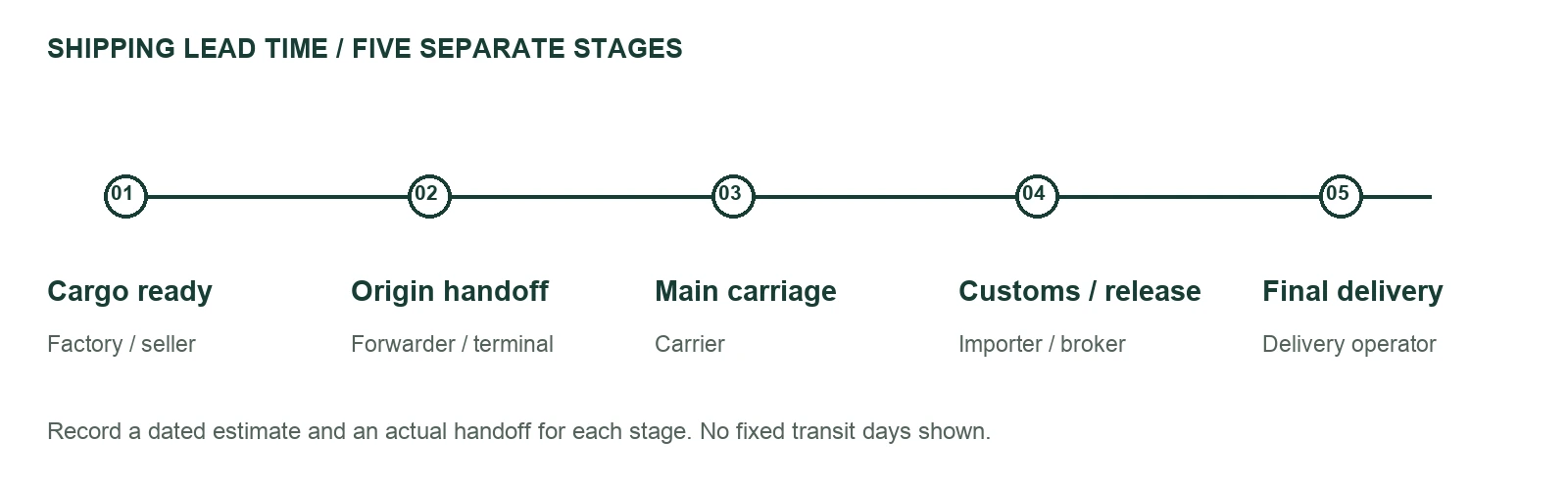
Cargo ready
Prepare: Agree the final carton specs and the ready date.
Delay signal: Production late, or carton data still changing.
Origin handoff
Prepare: Send shipping instructions and documents before the cut-off.
Delay signal: Missing papers, late pickup or a missed cut-off.
Main carriage
Prepare: Keep the booking confirmation and watch for schedule changes.
Delay signal: Full vessels, rerouting or a missed connection.
Customs and release
Prepare: Give the broker full product facts and documents early.
Delay signal: Questions on documents, an exam or another hold.
Final delivery
Prepare: Book a delivery slot and pay local charges.
Delay signal: No receiving slot, unpaid fees or terminal delays.
US Customs Clearance and HTS Codes for Imports from China
To clear U.S. customs on goods from China, you need a commercial invoice, a packing list, the transport document (bill of lading or air waybill) and an HTS code for each product. The importer of record is responsible for the entry, even when a broker files it.
A licensed customs broker files the entry for most commercial shipments. You will usually need a customs bond as well. For ocean cargo, the Importer Security Filing (ISF, often called “10+2”) must reach CBP at least 24 hours before the cargo is loaded in China.
Give your broker a factual product description, materials, use and origin. A supplier’s code is a starting point. Use the guide to find the HTS code and check that invoice, packing list and B/L match.
Duty rates change, so check the current USITC schedule and CBP guidance for your entry date. Links checked 20 October 2026.
Worked Example: Comparing Two Shipping Quotes
To compare two shipping quotes fairly, put them on the same start point, end point and currency, then add every missing cost. Say Quote A is “FOB air freight” and Quote B is “DDP express.” Ask the senders to explain the terms first. Under Incoterms 2020, FOB is a sea and inland-waterway rule; it doesn’t fit air freight.
Next, set the same pickup and delivery points. Keep each original base price. Then add only the costs each quote leaves out. For Quote A, that often means U.S. brokerage, duty and delivery. For Quote B, confirm who is the importer and what duty basis the carrier used.
Real quotes change by week, so fill in the table with your own dated quotes.
| Comparison item | Quote A · Air offer | Quote B · Express offer |
|---|---|---|
| Original trade-term label | “FOB air freight” — ask what it really covers. | “DDP express” — ask for the named place and importer. |
| Common endpoints | Set factory to your warehouse. | Set the same factory and warehouse. |
| Original base amount | Enter the dated quote. | Enter the dated quote. |
| Additional charges | Add origin fees, U.S. brokerage, duty and delivery if excluded. | Add any exclusions and check the duty basis. |
| Aligned total / difference | Compare only once both rows are complete. | A missing line can flip which quote is cheaper. |
Prepare the Cartons Before They Leave China
Check carton sizes, shipping marks and the packing list before the goods leave China, because relabelling at a U.S. port is slow and expensive. If the carton specs change, tell the forwarder at once, since the chargeable weight may change too.
At ASG, this is the Pre-Dispatch stage, the last of our four QC stages: Supplier Audit, Production Monitor, Warehouse Check and Pre-Dispatch. In our Shenzhen and Dongguan warehouses, we measure and weigh the cartons, check the shipping marks and photograph them. Then we match the counts to the final packing list.
For mark layouts and barcodes, see carton shipping marks.


Download the Shipping Quote Comparison Sheet
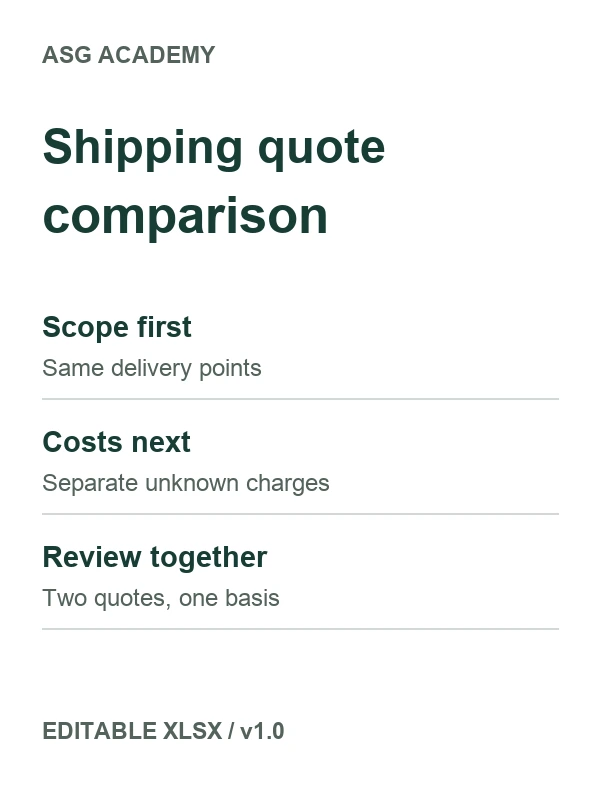
The shipping quote comparison sheet lines up two dated quotes on the same delivery point and currency. Add any excluded cost once and leave unknown costs blank. The sheet won’t show a price gap until every line is filled. Then carry the result into your landed cost.
Questions About Shipping from China to the US
How much does it cost to ship from China to the USA?
For a 1 kg air parcel, most base quotes ASG received in October 2026 ran $18–$27; a 2 kg parcel ran $31–$46. Larger cargo is priced per kilo or per CBM, and a full container costs least per unit. Duty, remote-area fees and delivery are extra. Get dated quotes for your exact cargo.
How to estimate shipping costs from China?
Start with the packed carton sizes and weights. Work out total CBM and the chargeable weight, then ask two or three forwarders to quote the same pickup and delivery points. Add origin fees, destination fees, brokerage, duty, insurance and delivery. Use the comparison sheet above to line them up.
Is China shipping to the USA right now?
Yes. Express, air and ocean services from China to the U.S. were running when we checked carrier pages on 20 October 2026. Schedules, surcharges and cargo rules can still change. Check the carrier’s current notices and confirm your booking before the goods are ready.
Can I get stuff shipped from China to the USA?
Yes. Commercial goods ship from China to the U.S. every day by express, air and sea, once the product meets U.S. entry rules. Give your forwarder and broker the goods description, origin, carton sizes and delivery address. Some products, such as batteries, need extra documents.