


Three Layers of Marking: Product Barcode, Carton Marks, Platform Labels
Goods from China carry three layers of marking, and each one answers a different question. The product barcode tells a store which product this is. The carton shipping marks tell the forwarder and warehouse which box this is. A platform label, such as an Amazon FBA label, tells that platform’s warehouse where the item or carton belongs.
One layer does not replace another. For each layer, decide who supplies the file, who prints it and who checks it. Give the factory the real file and its version number, not a photo of someone else’s label. Platform rules change, so note the date you checked them.
This guide is part of our import from China guide.

| Layer | Who supplies it | When to send it |
|---|---|---|
| Product barcode | You or your brand owner: the assigned GTIN and the approved barcode file. | Before the packaging artwork is approved. |
| Carton shipping marks | You set the fields; the factory fills in the real packed facts. | Before cartons are printed and the packing list is final. |
| Platform labels | You, from the platform’s current shipment files. | After you create the shipment on the platform. |
Which Barcode Goes on Your Product Packaging
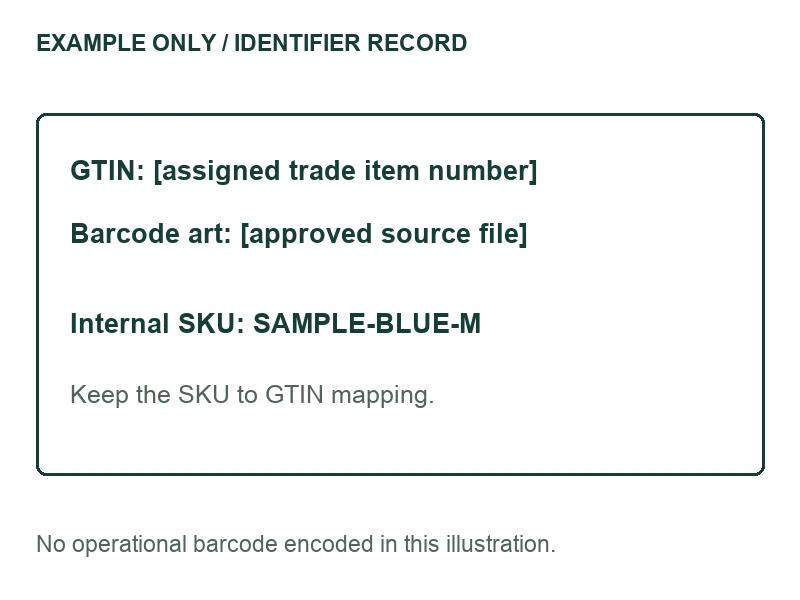
The barcode on your product packaging should be a GS1 UPC-A or EAN-13 that carries your product’s GTIN. A GTIN (Global Trade Item Number) is the number that identifies one product version. UPC-A holds a 12-digit GTIN; EAN-13 holds a 13-digit one. A SKU is your own stock code. You make it up, and no store system reads it as a GTIN.
Get the GTIN from GS1 or your brand owner, and send the factory the barcode file at its final print size. GS1 US asks for a clear margin around the bars and full bar height. Tell the factory not to stretch, crop or shrink the file to fit the panel. Then scan the printed sample.
Platforms have their own rules. Amazon’s US FBA help page lists barcode changes from 31 March 2026. Check your own account and product before you choose manufacturer barcodes or Amazon labels.
| Code | Where it comes from | What it does | What to check |
|---|---|---|---|
| GTIN / UPC / EAN | GS1, via you or the brand owner. | Identifies the product in stores and marketplaces. | Does the scan match the right variant? |
| Internal SKU | Your own inventory system. | Tracks stock and variants for you. | Is it mapped to the right GTIN? |
| Platform code (e.g. FNSKU) | The platform, for your account. | Tracks your unit in that platform’s warehouse. | Is the file current for this shipment? |
Shipping Marks: What to Print on Each Carton
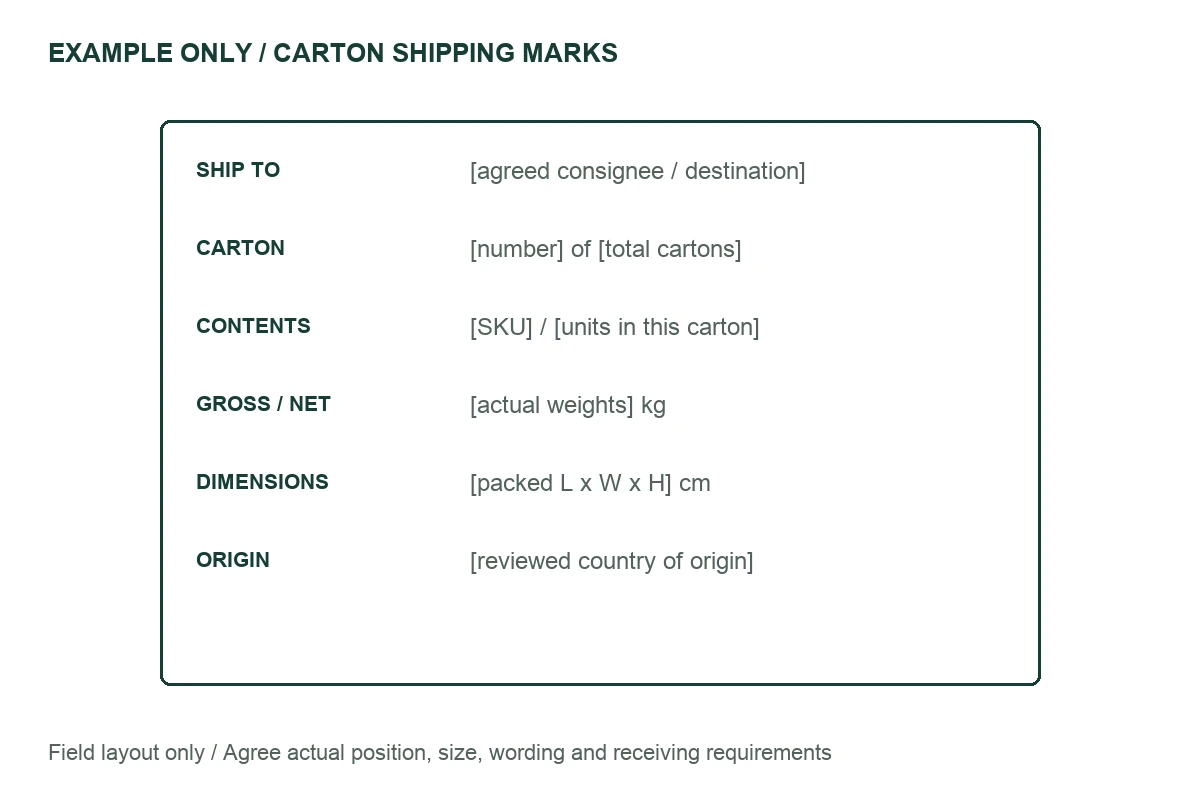
Shipping marks are the text printed on each export carton so the forwarder and the warehouse can match it to the packing list. Print the consignee or destination, the carton number out of the total, the SKU and quantity, gross and net weight, carton size and the origin mark. Write the units on every number.
Some warehouses want extra codes, such as a shipment or PO number. Ask for their rules before you print. If cartons are split, mixed or repacked, update the marks and the packing list together. Ask the factory for a photo of a full carton face before mass packing.
Battery goods need more than this. See UN3481 battery marks on cartons. A normal shipping mark does not replace dangerous-goods marks.
| Field | Where to print it | What to write |
|---|---|---|
| Consignee and destination | Main side panel. | Name or code and destination city or port. |
| Carton number and total | Same spot on every carton. | “Carton 3 of 120.” |
| SKU and quantity | Contents field. | Units per carton; list each SKU in a mixed carton. |
| Gross and net weight | Packed-facts field. | Real weights, with kg or lb. |
| Carton size | Packed-facts field. | Length × width × height, with cm or in. |
| Country of origin | Where it is easy to see. | “Made in China.” |

Made by PRC: Country of Origin Marking for Goods from China
US law requires imported goods to show the English name of the country of origin, legibly and permanently, in a place the buyer will see. For goods from China, “Made in China” is the plain choice. “Made in PRC” means made in the People’s Republic of China. “Made by PRC” is a common search phrase, not a wording to copy.
Before printing, confirm the exact text, position and how it is attached with your customs broker. Some goods are marked on the item; some exceptions allow the outer box. Check current guidance on the CBP site.
CBP: country of origin marking →Warning and Compliance Labels to Check
Warning and compliance labels depend on your exact product and market, so decide which ones apply before you brief the factory. Then send the approved wording, language, position and artwork. Never ask a factory to copy the warning panel from a similar item.
Do CPSIA rules apply to your product?
Yes, if it is a children’s product, meaning it is designed mainly for children 12 or under. It then needs permanent tracking labels and a Children’s Product Certificate (CPC) based on lab tests. A printed label does not replace the testing. Read CPSIA rules for children’s products.
Do you need a Prop 65 warning?
Only if your product can expose California buyers to a chemical on the Prop 65 list. The seller must judge that exposure. Don’t copy a warning from a similar product. Read when Prop 65 warnings apply.
What must a textile label show?
A textile label must show fiber content, country of origin and the maker or seller’s name or RN number. Most apparel also needs a care label. Read textile labeling requirements.
| Label | When to check it | What to send the factory |
|---|---|---|
| Small parts and choking warnings | Toys and games for young children. | Exact warning text and its place on the box. |
| Plastic bag warnings | Products packed in plastic bags. | Warning text and language for the states you sell in. |
| Stuffed product labels | Plush toys, pillows and similar goods. | Whether a state filling-content label applies. |
| Instructions and language | Any product with user steps. | Which languages you need for your market. |
Packaging a Product for Export Cartons
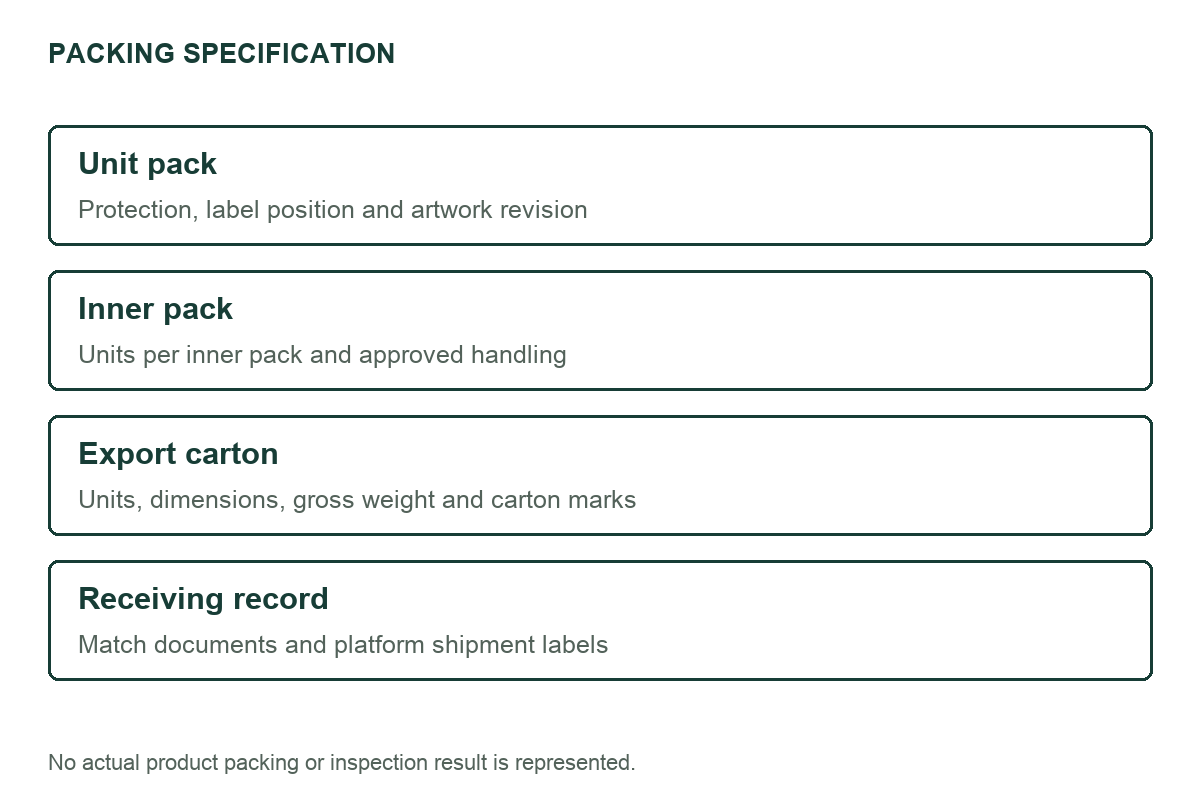
To package a product for export cartons, describe every level in writing: the product in its own pack, any inner pack, and the export carton. For each, list the material, how it closes, units per pack, carton quantity, outer size and gross weight. If the product ships in a plastic bag, settle any bag warning first.
Keep the packaging artwork tied to this spec. A new material, fold or carton count can hide a label or make a barcode hard to scan. Approve a packed sample, not just a picture of the artwork.

Match Carton Marks to Your Packing List
Your carton marks must match your packing list line by line before the goods leave China. Check carton numbers, contents, unit counts, gross and net weights, sizes and shipment codes. Use the same units on both.
Use our packing list carton fields with the packed cartons beside you. If a carton is split or replaced, fix the marks and the papers together. Log any mismatch and who will fix it.
| Carton mark | Packing-list line | What to check |
|---|---|---|
| Carton number | Carton number or range, and the total. | Check every physical box. |
| Contents | SKU lines and unit counts. | Spell out mixed cartons. |
| Weights | Gross and net, with units. | Use the final packing version. |
| Size and count | Outer size and carton count. | Update after any repack. |
| References | Shipment and receiving codes. | Use the same code everywhere. |
Check Labels Before the Cartons Are Sealed
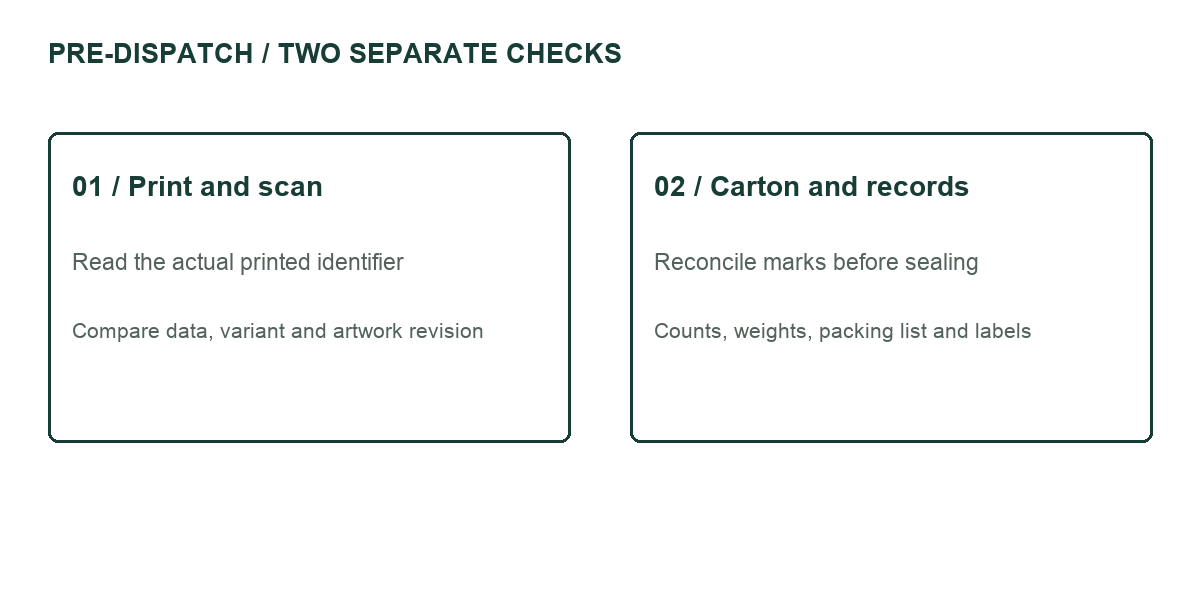
Check labels before the cartons are sealed, because a fix after sealing means opening every box. Scan the printed barcode and compare the result with the right product variant. Compare each label with the approved artwork. Match carton numbers, counts and weights to the packing list, and confirm the origin mark is in place.
At ASG this is part of Pre-Dispatch, the last of our four QC stages. In our Shenzhen and Dongguan warehouses we check label accuracy and packaging, measure cartons, check shipping marks and photograph the goods before they leave.
To build these checks into your order, add labeling checks to your inspection. Keep the sample, artwork version, measurements and results with the order.
Download the Factory Labeling Brief
Send your factory one file that covers barcodes, carton marks, packaging and warning labels. The Word brief has a carton-mark example and a warning-label table with official links. Fill it in and attach your approved artwork.
Send Your Factory a Labeling and Packaging Brief
Prepare the barcode files
List the GTIN, your SKU and the barcode file name, version and print size. Keep platform labels in a separate folder so the factory doesn’t mix them up.
Set the carton layout
List the fields, numbering, quantities, weights and sizes. Confirm print size and position with the receiving warehouse. Ask for a proof of a full carton face.
Attach the brief to the order
Name the brief version when you add a labeling brief to your purchase order. Keep the factory’s written confirmation with the order.
Approve a printed sample
Scan it, read it and check the packing. Note the sample number, who checked it, the date and any open issues. Recheck after any change.
Questions About Packaging Barcodes
How to get a barcode for packaging?
Buy a GS1 company prefix or a single GTIN from GS1 US, assign the number to your product, then make the barcode file. Send that file to your factory at its final size. If you sell on Amazon or another platform, check its barcode rules too. Never copy a barcode from another product.
What is a SKU vs. barcode?
A SKU is your own stock code; a barcode is a machine-readable symbol. On retail packaging, the barcode usually carries a GTIN from GS1. Your SKU lives in your inventory system and maps to that GTIN. Give the factory both so it prints the right barcode on each variant.
How do I create a barcode for a product?
First get a GTIN from GS1, then turn it into a UPC-A or EAN-13 barcode file. GS1 US and many design tools can generate the file. Keep the size, the clear margin and full bar height. Scan a printed sample before mass printing.
What is the purpose of a barcode on product packaging?
A product barcode lets a scanner read the product’s GTIN and pull up its record at checkout or in a warehouse. It identifies the product, not the carton or the shipment. A clean scan does not prove origin marking or safety labels are right. Check those on their own.
Can I sell products without a barcode?
Yes, in some channels. Your own website or a local market often needs none. Most retailers and big marketplaces do require one. Amazon may allow exemptions in some cases. Check the current rules for your exact product and channel before you print packaging.
Where is something made if it’s Made in PRC?
It was made in China. PRC stands for the People’s Republic of China. For your own goods, “Made in China” is the plain wording. Confirm the exact text with your customs broker. Related reading: what Made in PRC means.